
Chili peppers are arguably one of the most noticeable seasonings on the dining table. Some people cannot live without their fiery kick and firmly believe that a meal without spice is not a meal at all. Others avoid them, worrying that spicy foods may irritate the stomach and intestines.
For a long time, debate has persisted over whether chili peppers are good or bad for health. However, a recent large longitudinal study based on a multi-ethnic Chinese cohort has offered a new perspective: people who regularly consume spicy foods tend to show slower biological aging across multiple organ systems, particularly in metabolic and kidney-related measures. This suggests that spicy food may quietly influence the pace at which our bodies age.
Do People Who Regularly Eat Spicy Food Really Age More Slowly at the Biological Level?
Why might spicy food influence the body’s “biological clock”?
The key may lie in the interaction between capsaicin and the TRPV1 receptor. This stimulation does not stop at the tongue. It can trigger calcium influx, inflammatory pathways, and metabolic signaling, potentially affecting energy use, blood lipids, blood glucose, and other processes closely related to aging.
With this biological mechanism in mind, it becomes meaningful to ask: do people who eat spicy food regularly actually experience slower biological aging?
To investigate this question, researchers selected 7,874 adults from the China Multi-Ethnic Cohort (CMEC) who completed both baseline and follow-up assessments. Using participants’ frequency of spicy food intake over the previous month as the exposure variable, the researchers analyzed changes in composite biological age across the cardiopulmonary, metabolic, liver, and kidney systems.
The results were quite intriguing. Compared with people who rarely or never ate spicy food, those who consumed spicy food 3–5 times per week showed a reduction of approximately 0.69 years in composite biological age acceleration. Those who ate spicy food 6–7 times per week showed a reduction of around 0.32 years, while eating spicy food only 1–2 times per week was not associated with a statistically significant reduction.
When individual organ systems were examined, the strongest associations were observed in the metabolic and kidney systems. Consuming spicy food 3–5 times per week was associated with slower metabolic aging (-0.76 years) and slower kidney aging (-1.89 years). Differences in cardiopulmonary and liver aging were smaller or less consistent.
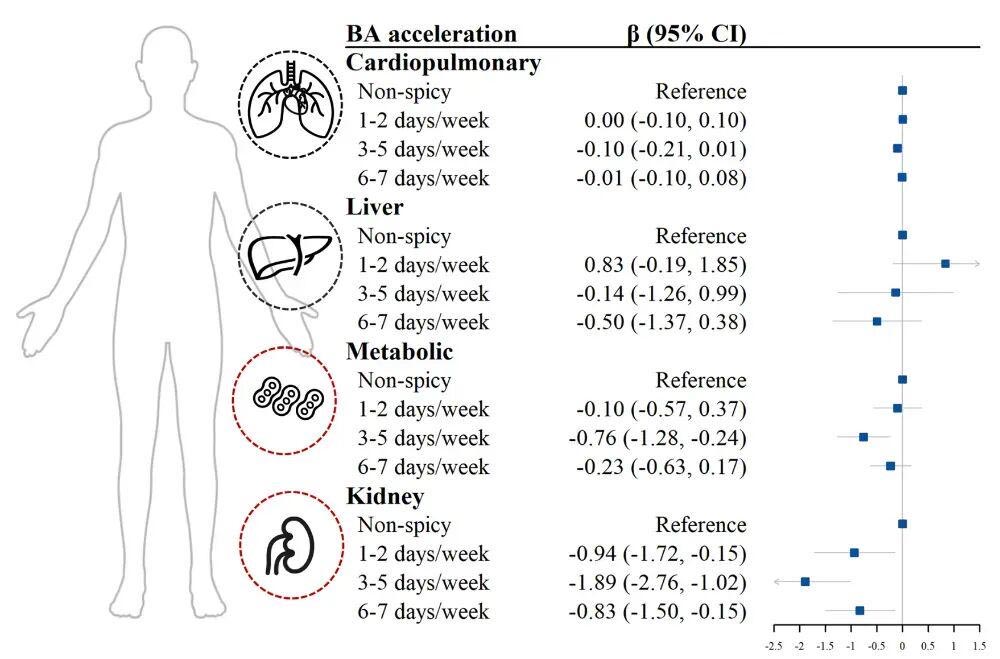
Associations Between Spicy Food Consumption and Biological Aging Across Multiple Organ Systems
The study also suggested that the association was more pronounced among women, Han Chinese participants, and individuals with generally healthier dietary patterns. The findings remained robust across multiple sensitivity analyses.
Why might 3–5 times per week appear to be the most favorable frequency?
On the one hand, TRPV1 is distributed throughout tissues such as the kidneys, adipose tissue, and vascular endothelium. Moderate capsaicin stimulation may support sodium excretion, lipid and glucose metabolism, and endothelial function. As a result, its effects may be more readily reflected in the “metabolic–kidney” axis as slower biological aging.
On the other hand, excessively frequent or intense stimulation may lead to TRPV1 desensitization and a ceiling effect in bioavailability, meaning that the benefits may no longer increase with greater intake. This is consistent with the threshold effect observed in the study.
That said, it is important to emphasize that this was an observational longitudinal study. Although the researchers controlled for many potential confounding factors, the findings cannot establish a causal relationship.
At this point, the relationship between chili peppers and health appears far more complex than we may have assumed. Spicy food may be beneficial in some situations, yet burdensome when consumed excessively. This raises an important question: are chili peppers a health-promoting food, or a hidden dietary risk?
To answer that question, evidence from different studies needs to be considered together.
Loving Spicy Food: Benefits and Risks
In a large Chinese prospective study involving nearly 500,000 people and spanning 12 years, individuals who regularly consumed spicy food had lower risks of vascular disease than those who rarely ate spicy food. The association was particularly evident for ischemic heart disease and major coronary events.
Researchers suggested that capsaicin may contribute by improving vascular endothelial function and regulating inflammatory responses. This makes the habit of eating spicy food appear to offer at least some cardiovascular protection.
Supporting this idea, an integrative review found that capsaicin may play positive roles in metabolic regulation and may also have antioxidant and neuroprotective potential. These findings have increased interest in the possible health benefits of chili peppers.
However, other studies suggest that frequent spicy food consumption should be approached with caution.
A cross-sectional study conducted in rural Southwest China found that the more frequently people consumed spicy food, the higher the prevalence of overweight and obesity. Among those who ate spicy food almost every day, the risk of obesity was even substantially higher. This may be partly because spicy food is often consumed alongside high-fat and high-salt dishes.
The same review also noted that high doses or long-term excessive intake of capsaicin may irritate the gastrointestinal tract. Potential effects may include worsening reflux symptoms or impairing the esophageal mucosal barrier, particularly among people with gastroesophageal reflux disease (GERD) or heightened gastrointestinal sensitivity.
Interestingly, the appeal of spicy food is not limited to taste.
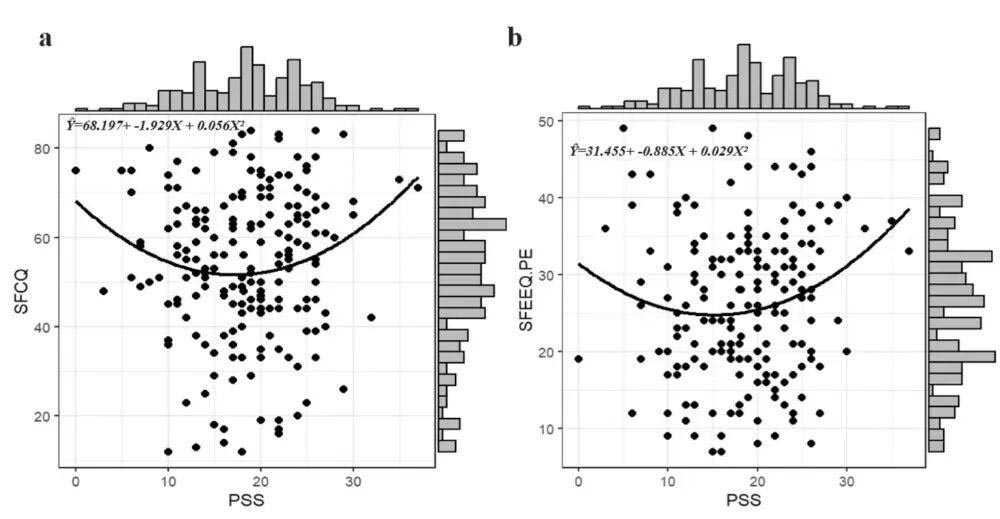
A psychology experiment found that, among young women, perceived stress and the desire to eat spicy food followed a U-shaped relationship. The desire for spicy food was strongest when stress levels were either very low or extremely high. This desire was often driven by the positive emotional experience associated with eating spicy foods.
In other words, chili peppers are not merely food. They can also function as a form of emotional comfort: offering stimulation and excitement during emotional lows, and providing a brief sense of release under intense stress.
Figure A: U-shaped relationship between perceived stress and the desire to eat spicy food.
Figure B: U-shaped relationship between perceived stress and positive emotional experience.
Therefore, chili peppers are neither simply a health-protective food nor merely a dangerous dietary trap. They are more like a mirror, reflecting both an individual’s physical condition and psychological needs.
How Should We View Spicy Food Scientifically?
The effects of chili peppers on the body are not simply “good” or “bad.” They depend on frequency of intake, individual differences, and the broader dietary context.
The studies discussed above suggest that a moderate frequency of about 3–5 times per week may be more favorable for maintaining a stable biological rhythm. This indicates that regular, moderate consumption may matter more than either occasional experimentation or excessive indulgence.
At the same time, differences between individuals deserve attention. In some regions, spicy food is often consumed as part of a high-oil, high-salt dietary pattern, which may increase the risk of obesity among people who eat spicy food excessively.
For individuals with fast metabolism and healthy digestive systems, chili peppers may be a helpful part of the diet. But for people who already have obesity, gout, gastrointestinal sensitivity, or reflux-related conditions, excessive spicy food intake may worsen existing problems.
Beyond physical health, chili peppers can also play a distinctive psychological role. They may bring stimulation and excitement during emotional lows, or offer temporary relief under high stress. However, when spicy food becomes the only way to cope with pressure, it may turn into another form of dependence.
Viewing spicy food scientifically does not mean labeling it as simply “healthy” or “harmful.” Instead, it means learning to maintain balance: an appropriate frequency, suitable individual circumstances, healthier cooking methods, and greater awareness of one’s emotional needs.
Only then can chili peppers truly serve as a flavorful companion in daily life rather than a potential burden.
References
[1] Zhang N, Hong F, Xiang Y, et al. Spicy food consumption and biological aging across multiple organ systems: a longitudinal analysis from the China Multi-Ethnic cohort. Nutr J. 2025;24(1):86.
[2] Doligalska M, Zieliński D, Bachoń E, et al. Health implications of capsaicin: Weighing the benefits and risks of spicy foods—a review of the literature. Med Sci. 2025;29:e16ms3515.
[3] You D, Sun D, Zhao Z, et al. Spicy food consumption and risk of vascular disease: Evidence from a large-scale Chinese prospective cohort of 0.5 million people. Chin Med J (Engl). 2025;138(14):1696-1704.
[4] Xiong H, Zhao P, Ma F, et al. Spicy food intake and overweight/obesity in rural Southwest China:
If there is any infringement, please contact us for removal.