
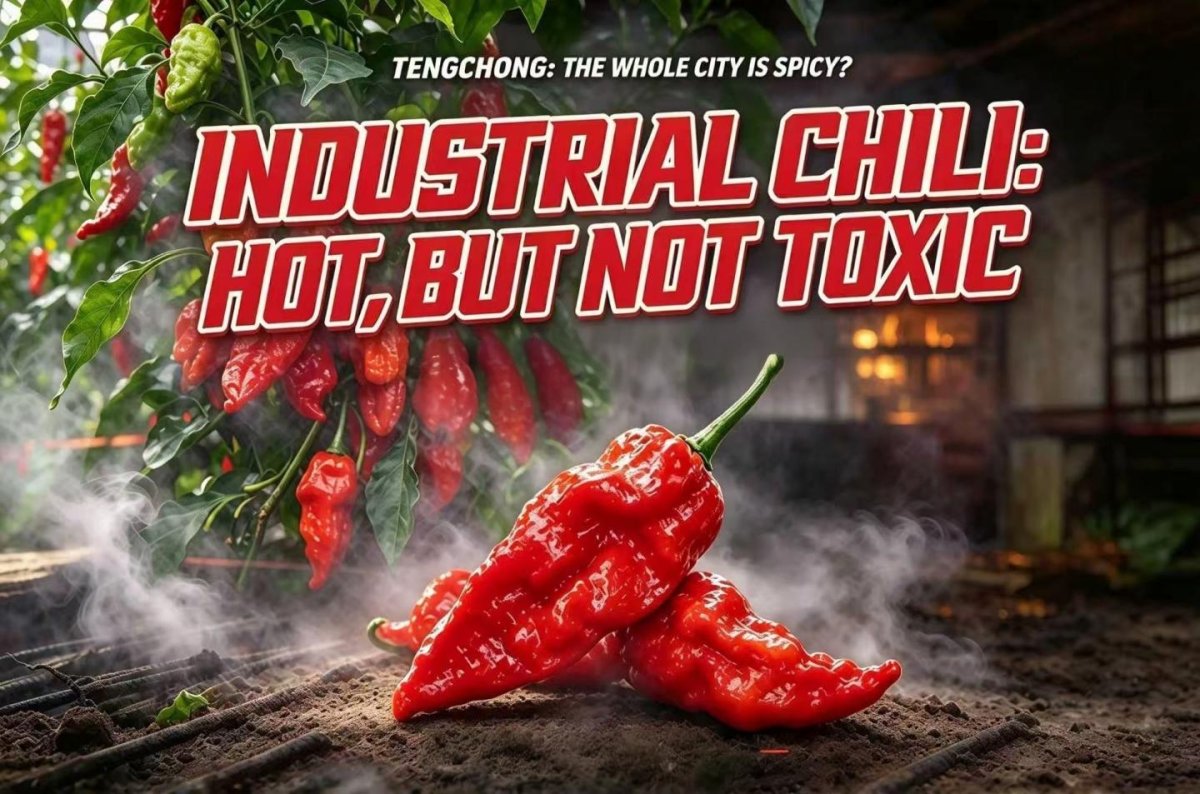
On October 25, 2026, a fire broke out at an industrial chili-drying facility in Beihai Township, Tengchong, Yunnan Province. The blaze ignited stockpiles of high-heat industrial chilies (dubbed “ghost chilies” or “Shuanshuan La” by netizens). Thick smoke laden with capsaicin drifted with the wind into the urban area. Numerous local residents reported a powerful irritating tang hanging in the air. Many suffered fits of coughing and sneezing, along with a burning stinging sensation on their faces. Online discussions blew up with posts claiming “the whole city of Tengchong is coughing”, and many netizens quipped, “They must have burned ghost chilies.”
On October 26, local Tengchong authorities issued a response. The fire was quickly put out and the site cordoned off and sealed. Environmental protection agencies carried out real-time air monitoring, confirming that the sharp smell was merely a sensory irritation caused by capsaicin and posed no threat to human health. Odors were expected to dissipate within the day. Residents were advised to wear masks temporarily and keep windows and doors closed to minimize discomfort. There were zero casualties from the fire.
Many people’s first thought was: “Industrial chili? Is this some toxic chemical product?”
As an industry veteran, I would like to use this trending incident to explain exactly what industrial chili is and whether it is truly poisonous.
Here is the straightforward conclusion: Industrial chilies are extremely hot, but they are non-toxic.
Three key facts back this up.
Ⅰ Industrial chili is not a chemical product — it is genuine chili
Hearing the term “industrial chili”, many draw parallels with “industrial-grade alcohol” or “industrial-grade salt”, assuming it is some hazardous man-made chemical.
This could not be further from the truth.
Industrial chilies are chili varieties purpose-bred for industrial-scale extraction. Fundamentally, they belong to the same family as table chilies such as bird-eye chilies and cayenne peppers — they are all chilies.
The only difference: they are far hotter.
Ordinary chilies register at tens of thousands of Scoville Heat Units (SHU). Industrial chilies can hit 800 000-1 000 000 SHU or higher. Their extreme heat makes them highly efficient and cost effective raw material for extracting oleoresin capsicum, capsaicin and capsanthin.
They are not chemically synthesized. They are naturally grown farm produce.
Why did the pungent fumes blanket Tengchong? The fire at the drying house sent fine chili particulate matter swirling into the air. Capsaicin is inherently intensely irritating. Slicing bird-eye chilies can burn your hands — imagine airborne chili dust at a million SHU heat level.
Heat does not equal poison. Heat is capsaicin stimulating nerve endings to produce a burning sensation, yet capsaicin itself is not toxic. Think of sweating and streaming eyes and nose from an extra-spicy hot-pot meal: you feel the heat, you are not poisoned.
Ⅱ Capsaicin is globally recognised as a safe substance
Few people realise capsaicin is the compound responsible for chili’s heat.
- Food industry: Oleoresin capsicum and capsaicin extracts are legally permitted food additives in national standards. They are found in roughly 90 % of spicy food products including spicy gluten snacks, hot-pot bases, marinated duck products and chili sauces.
- Pharmaceutical industry: Topical capsaicin patches are used for pain relief, treating arthritis, muscular aches and neuralgia. Well-known pharmaceutical firms such as Yunnan Baiyao develop related medicinal products.
- Agriculture: Capsaicin serves as a biopesticide. It repels rather than kills pests, offering an eco-friendly alternative.
- Security and defence: Many tear-gas formulations use capsaicin as their irritant agent — it inflicts intense discomfort without causing permanent bodily harm.
Leading regulators including the US FDA, European EFSA and Chinese national authorities endorse capsaicin’s safety. Properly extracted and applied, it presents no health risk.
This aligns with the official Tengchong statement confirming the fumes posed no health hazard. Chili dust irritates the respiratory tract and eyes and causes discomfort, yet it does no lasting physical damage.
Ⅲ The industrial-chili sector represents a new growth frontier for Chinese agriculture
Industrial chilies may sound unfamiliar to the general public, yet the industry is substantial. Provinces across China including Yunnan, Guizhou, Xinjiang and Henan are expanding industrial chili cultivation. These crops deliver far better economic returns than ordinary table chilies:
- Fresh common chili sells for a few yuan per kilogram.
- Dried industrial chili fetches dozens of yuan per kilogram.
- Refined derivatives such as oleoresin capsicum and capsaicin command even higher prices.
This broad range of applications drives demand: food processing, pharmaceutical analgesics, biopesticides, non-lethal security-defence equipment and cosmetics. Ultra-high-purity capsaicin (over 99 %) is a scarce high-value commodity priced by the gram.
China is the world’s largest chili producer and the top exporter of chili extracts. Chili and deep-processed chili goods from Zunyi have already generated tens of millions in export revenue this year, with rapid ongoing growth.
Far from being some shady chemical enterprise, industrial-chili production exemplifies characteristic agriculture plus deep-processing, supporting rural revitalisation and raising farmers’ incomes.
Closing Thoughts
The Tengchong incident was an accident: a drying-house fire scattered chili dust across the city.
Paradoxically, it sparked widespread public education about industrial chilies: many learned just how blisteringly hot some chilies can be, and the diverse industrial uses of chili crops.
As practitioners at Jindao Capsaicin Technology, we wish to emphasise: Industrial chilies are fiercely hot and powerful, yet non-toxic, harmless and naturally farm-grown. They are valuable agricultural commodities, boosting farmers’ livelihoods and supplying key raw materials for food, medicine, agriculture and multiple other sectors.
Next time you encounter the phrase “industrial chili”, do not picture toxic chemicals. It is simply chili — just far hotter than most.