
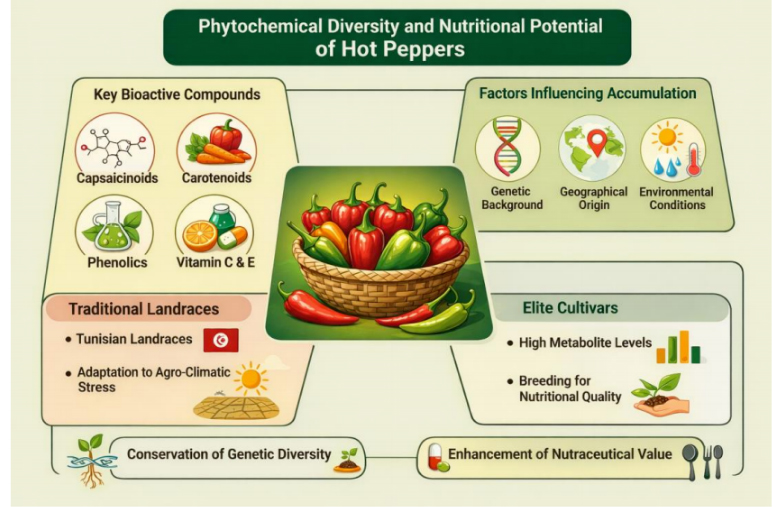
Chili peppers (Capsicum spp.) are among the most widely consumed vegetables globally; beyond imparting unique flavors and colors to dishes, they serve as vital dietary sources of health-promoting compounds such as capsaicin, carotenoids, tocopherols (vitamin E), phenolic compounds, and vitamin C. These metabolites—which possess antioxidant and anti-inflammatory properties and help prevent metabolic and degenerative diseases—have levels that are profoundly influenced by genetic background, geographical origin, cultivation environment, and maturity stage. However, a comprehensive integration and systematic comparison of the five major classes of bioactive compounds across diverse global chili germplasms—along with an understanding of their regulatory mechanisms—has been lacking. Recently, Marwa Chouikhi and colleagues from the Horticulture Laboratory at the National Institute of Agronomy of Tunisia published a review article systematically analyzing literature data on hundreds of chili varieties from over ten countries—including Mexico, the United States, South Korea, Hungary, Greece, and Tunisia. This work provides the first panoramic view of how genotypic and environmental factors synergistically shape the nutritional quality of chili peppers, while specifically highlighting the unique characteristics of Tunisian landraces.
Using a literature review approach, the research team searched for and screened authoritative studies published between 2000 and 2024 regarding the levels of capsaicin, carotenoids, tocopherols, total phenolics, and vitamin C in chili pepper fruits; the data encompassed various cultivation years, planting systems (open-field, greenhouse, and shade-net house), and stages of maturity. Through comparative analysis, the team quantified the global range of variation for each constituent and determined the relative contributions of genetic potential and environmental plasticity.
Capsaicin content varies drastically, ranging from 0.0 μg/g fresh weight in sweet pepper varieties (e.g., the Mexican ‘Dulce’) to over 300,000 μg/g in super-hot varieties (e.g., the US ‘Ixtapa’). Content within the same variety can differ by an order of magnitude depending on conditions; for instance, the Thai variety ‘Phet Mordindang’ reached 388 μg/g when grown outdoors in Thailand but only 40 μg/g in a US greenhouse, highlighting the powerful regulatory effects of temperature, light, and water stress. Tunisian landraces exhibited capsaicin levels of only 1.81–193.71 μg/g—ranging from mild to moderately hot—reflecting local dietary preferences and ecological adaptations.
Korean varieties led significantly in carotenoid content; ‘IT261426’ reached as high as 24,308.5 μg/g, whereas most Italian and Tunisian varieties contained less than 200 μg/g. Although the Tunisian ‘Semmane’ (174.52 μg/g) had lower levels than the Korean varieties, it surpassed most Italian varieties and demonstrated superior environmental stability.
Regarding tocopherols (predominantly α-tocopherol), Hungarian varieties performed best, with ‘Unikal’ reaching 779.6 μg/g; Korean varieties fell in the middle range (134.8–255.1 μg/g), and Tunisian landraces showed the lowest levels (19.38–31.36 μg/g), suggesting that high Vitamin E accumulation requires a specific genetic background and suitable environmental conditions.
Total phenolic content was highest in the Greek greenhouse varieties ‘Yahoo F1’ (771.1 μg GAE/g) and ‘Florinis NS’ (700 μg GAE/g). Tunisian landraces also performed remarkably well, ranging from 168.58 to 302.98 μg GAE/g; notably, ‘Cayenne’ (302.98 μg GAE/g) exceeded most varieties from Romania, Spain, and Egypt, demonstrating excellent antioxidant potential. Vitamin C content was highest in the Greek cultivar ‘Florinis NS’ (1550 μg/g), while the Tunisian cultivar ‘Nabeul’ (200 μg/g)—comparable to high-content Romanian varieties (204 μg/g)—serves as a prime local parent for breeding programs aimed at enhancing Vitamin C levels.
Patterns of Genotype-Environment Interaction: Content levels for the same cultivar can vary several-fold to dozens-fold depending on the country or cultivation system. High temperatures, intense light, and moderate water stress promote capsaicin accumulation; conversely, while greenhouse conditions reduce pungency, they favor the synthesis of Vitamin C and phenolic compounds. The superiority of Korean and Hungarian cultivars regarding carotenoids and tocopherols stems from the sustained high expression of specific genotypes. Meanwhile, Tunisian landraces demonstrate a dual advantage of genetic resilience and environmental buffering, maintaining stable phenolic and Vitamin C levels under stress conditions such as drought and high heat.
Conclusions and Breeding Implications: This review presents the first comprehensive map of variation across five major classes of bioactive compounds in global pepper germplasm, establishing that genetic background dictates the upper limit of compound content, while environmental conditions significantly modulate the final phenotype. Although Tunisian landraces may not excel in pungency or certain fat-soluble vitamins, their high phenolic and Vitamin C content, combined with adaptation to harsh local climates, makes them invaluable genetic resources. The study advocates for a balanced approach in future quality-oriented breeding—integrating the high-yield potential of elite cultivars with the adaptability and nutritional stability of landraces—and utilizing marker-assisted selection and gene editing to achieve targeted improvements in pungency, color, and antioxidant properties. This work provides a systematic data foundation and theoretical framework for the development of functional pepper products and sustainable breeding strategies.
Disclaimer: The information is sourced from industry research on chili peppers; please contact us for removal in the event of copyright infringement.