
Industrial chili peppers are transforming from “agricultural byproducts” into “high-tech raw materials.” A quiet industrial upgrade is already underway.
The Chili You Think You Know vs. the Real Chili — Not the Same Thing
When most people think of chili peppers, they think of hot pot, crayfish, Lao Gan Ma — condiments on the dinner table. But few realize that the real battlefield of chili peppers has long since left the kitchen. Roughly 80% of the global chili industry’s output value comes from “industrial chili peppers” — not meant to be eaten directly, but used as industrial raw materials to extract capsaicin, capsanthin (paprika red pigment), and oleoresin capsicum, which find their way into over a dozen downstream sectors including food, pharmaceuticals, cosmetics, military, and agrochemicals. This is a severely underrated market.
Over the past five years, the global industrial chili market has grown from under US$3 billion to nearly US$5 billion, with a compound annual growth rate exceeding 10%. In China, growth is even faster — demand for capsaicin alone is climbing at over 15% annually. But more noteworthy than the growth is the fundamental shift in the industry’s underlying logic.
In the past, industrial chili was an agricultural commodity business — “grow it, sell it” — competing on who had the highest yield and the lowest price. Today, it is becoming a “technology war” — competing on whose heat level is more stable, whose extraction purity is higher, whose product line is broader, and whose supply chain is more controllable. The raw material era is ending; the technology era has arrived.
Today we break down the six core trends shaping the industrial chili industry in 2026, and what industry leaders are quietly positioning themselves for.
Trend 1: Downstream Applications Explode — Demand Shifts from “Food Monopole” to “Multi-Polar Drivers”
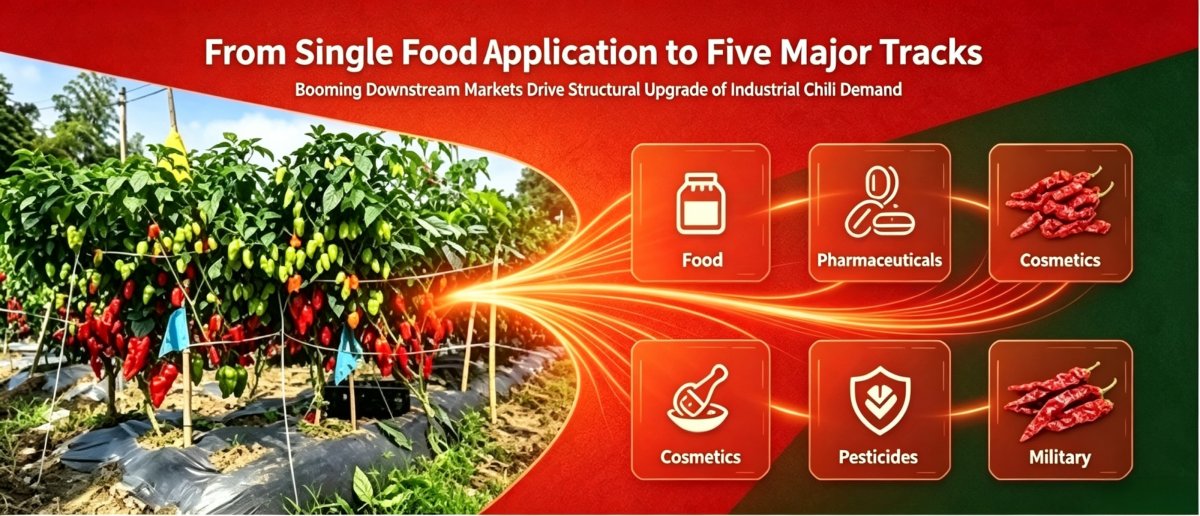
The demand structure of industrial chili is undergoing fundamental change. In the past, over 80% of industrial chili demand came from the food industry — spicy snacks, chili sauces, instant noodle seasoning packets — essentially still an “extension of condiments.” Today, that share is declining rapidly. Emerging applications are rising at a much faster pace.
The pharmaceutical sector is one of the fastest-growing tracks. High-purity capsaicin (99%+) is widely used in analgesic ointments, patches, arthritis medications, and even adjunctive tumor therapy. The explosion of the global pain management market has directly driven demand for pharmaceutical-grade capsaicin. Leading domestic pharma companies such as Yunnan Baiyao have already incorporated capsaicin-based products into their core pipelines.
The cosmetics and personal care sector is emerging as a new growth pole. Capsaicin’s heat-generating properties are applied in fat-burning creams, warming masks, and scalp care products. In 2025 alone, the number of new cosmetic SKUs containing capsaicin in China grew by over 40%.
The agrochemical and veterinary medicine sectors should not be overlooked either. Natural capsaicin, as a core ingredient in biopesticides, is replacing some traditional chemical pesticides due to its green, residue-free characteristics. China’s “zero growth in pesticide use” policy has further accelerated this process.
The military and security sectors represent another hidden but enormous market. Tear gas canisters, self-defense sprays, and riot control equipment — all rely on high-purity capsaicin as their core raw material. This field has extremely high requirements for purity and quality, and the highest barriers to entry.
In one sentence: the downstream of industrial chili is shifting from “walking on one leg (food only)” to a “five-horse gallop” — food, pharmaceuticals, cosmetics, agrochemicals, and military applications. This means demand volatility will be smaller — when the food industry is sluggish, pharmaceuticals and cosmetics may be growing. At the same time, it means higher product requirements — pharmaceutical grade and food grade are entirely different standards. It also means companies with only a single product will find it increasingly difficult to capture the industry’s growth dividends.
Trend 2: Heat Standardization Becomes Core Competitiveness
The industrial chili industry has a persistent headache — unstable heat levels. One batch of “chili powder” might register 800,000 SHU (Scoville Heat Units), while the next batch might only reach 500,000. In the same producing region, a rainy year means lower heat; a dry year means higher heat.
For downstream customers, this is unacceptable:
- In food production, inconsistent heat means inconsistent product taste — and consumer complaints.
- In pharmaceuticals, unstable heat means inaccurate active ingredient content — directly affecting efficacy and safety.
- In cosmetics, variable heat means products deliver inconsistent warming effects — and brand reputation collapses.
Heat standardization is evolving from a “nice-to-have” to an “entry ticket.” In the past, the industry’s common approach was “close enough” — give a rough range, and let customers blend it themselves. But now, downstream industry leaders are increasingly explicit: heat deviation per batch cannot exceed 5%, test reports are mandatory, and traceability is required.
This forces upstream companies to solve two problems:
First, seed stock must be stable.
Only with unified varieties and strong breeding technology can heat consistency be guaranteed at the source. That’s why capable companies in the industry are investing in breeding R&D — breeding experts like Professor Xu Huashun have become the scarcest resource.
Second, testing must be rigorous.
Every batch must undergo HPLC (High Performance Liquid Chromatography) testing, with SGS or COA (Certificate of Analysis) reports issued. Companies without testing capability don’t even qualify to submit a quote.
Under this trend, “consistently exceeding 1,000,000 SHU, balanced across batches with no drop-off” is evolving from a marketing slogan into the industry’s basic threshold. Those who cannot meet it will be gradually phased out.
Trend 3: Full Industry Chain Layout Becomes the “Moat” of Top Players
The industrial chili supply chain is long: breeding → planting → procurement → primary processing → deep processing → extraction → refining → finished products.
In the past, most companies in the industry only handled one link — there were seedling companies, planting bases, processing factories, extraction plants, each doing their own thing. But now, “full industry chain” is becoming standard equipment for leading enterprises.
Why? Because single-link operations face three fatal problems:
First, quality is uncontrollable.
Processing factories can’t dictate what varieties upstream grows, how they’re grown, or when they’re harvested. With unstable raw materials, even the most advanced equipment can’t produce consistent products.
Second, profits get squeezed.
Pure processors have to absorb raw material price increases and swallow product price drops — squeezed from both ends. In good markets, they earn modest labor money; in bad markets, they lose money outright.
Third, response speed is slow.
When a customer wants a customized product, you have to coordinate with the planting side, then the processing side, then the extraction side — the cycle stretches out, and the customer experience suffers.
A full industry chain layout solves all these problems at once:
- Start with the seeds — breed your own, raise your own seedlings; variety and quality are controllable from the source.
- Start with the bases — your own planting bases + contract farming; yield and harvest timing are under your control.
- Start with processing — your own primary and deep processing lines; produce whatever specifications you need.
- Start with testing — your own testing lab; every batch is tested, quality is in your own hands.
Having a full industry chain isn’t about showing off by being ‘big and complete’; it’s a necessary choice driven by the triple competition of quality, cost, and efficiency. That’s also why we see leading companies in the industry, like Chenguang Biotech and Hongxing Development, as well as emerging players like Jindao, all moving towards a ‘full industry chain’ in their own ways. Future competition won’t be between individual companies, but between entire industry chains.
Trend 4: Domestic Substitution Accelerates — High-End Capsaicin No Longer “Choked” by Imports
For a long time, there was an industry pain point rarely mentioned: high-purity capsaicin (99%+) mainly relied on imports. The global high-purity capsaicin market was long monopolized by a handful of European, American, and Japanese companies. Domestic Chinese companies could mostly only produce low-purity oleoresin capsicum (1%, 10%) — they “couldn’t handle” high purity. But this situation is being rapidly broken.
Domestic substitution is one of the most certain trends in the 2026 industrial chili industry. Three drivers are behind it:
First, technological breakthroughs.
Domestic companies have made rapid progress in extraction and refining technology. In the past, 99.99% purity was unattainable; now not only can it be achieved, but it costs over 30% less than imports.
Second, supply chain security.
The trade frictions between China and the US and geopolitical risks are making downstream companies pay more attention to ‘domestic substitutes.’ It’s especially obvious for pharmaceutical companies—they can’t let others control the key raw materials.
Third, policy promotion.
The state provides strong support for “chokepoint” technologies, and high-end bio-extraction technology is a key support direction. Domestic high-purity capsaicin is evolving from “usable” to “good to use,” and then to “preferred use.”
The impact of this trend is profound. It means the profit structure of China’s industrial chili industry will change — in the past, the most profitable high-end segment was taken by foreign companies; now domestic companies are starting to share the cake. It also means companies with technical capability will pull ahead of their peers — companies that can produce 99.99% high-purity capsaicin and those that can only produce 10% oleoresin capsicum are simply not competing on the same dimension. Furthermore, technical barriers are replacing price advantages as the industry’s new watershed.
Trend 5: Green, Organic, Traceable — Downstream Brands Force Upstream Upgrades
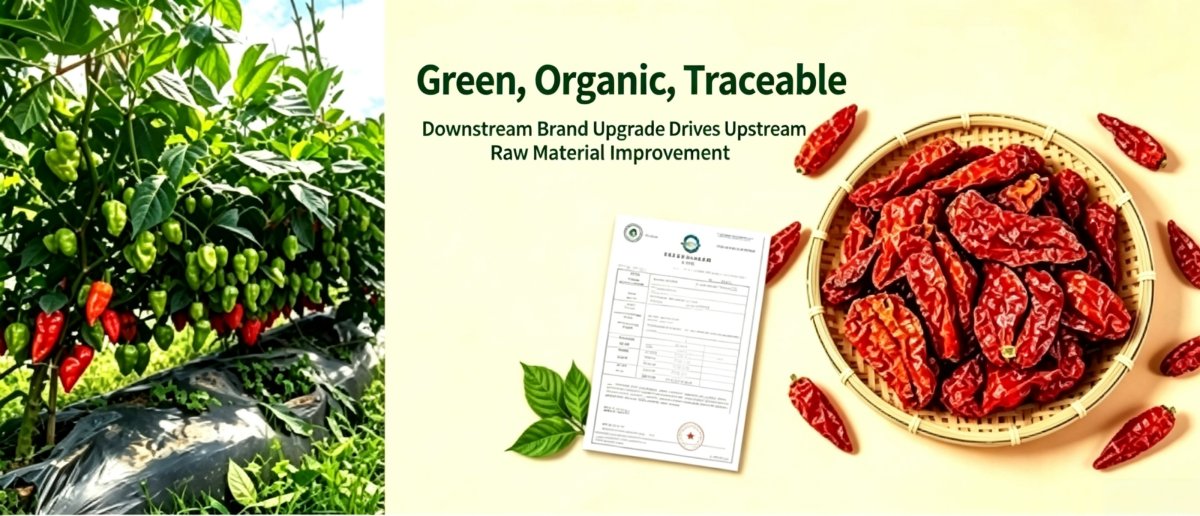
Changes on the consumer side are transmitting upward along the industry chain. Today’s consumers care increasingly about three things: Are the raw materials safe? Is production environmentally friendly? Is the source traceable? This pressure travels from brands to contract manufacturers, from contract manufacturers to raw material suppliers, and finally lands on upstream chili producers. Green, organic, and traceable are evolving from “optional” to “mandatory.”
Specifically, several notable changes are underway:
First, certification barriers are getting higher.
In the past, ISO 9001 was enough. Now customers want HACCP, HALAL, KOSHER, organic certification, BRC… Without these certifications, you can’t even get on the supplier list.
Second, environmental requirements are getting stricter.
Regulation of wastewater, exhaust gas, and waste residue treatment at extraction plants is tightening. Small enterprises that fail environmental compliance are shut down without hesitation. This is also an important driver of industry concentration.
Third, traceability systems are increasingly important.
Downstream brands require that every batch of raw materials can be traced back to which base, which variety, when it was harvested, and which processing steps it went through. Companies without traceability capability are being accelerated out of the market.
The impact of this trend on the industry is rising compliance costs — but compliance capability is also becoming a core competitiveness. Companies that can obtain full certifications, establish complete traceability systems, and achieve green production will win more orders from quality customers. Meanwhile, small enterprises that survive on “low cost, low standards” will find it increasingly difficult to sustain themselves.
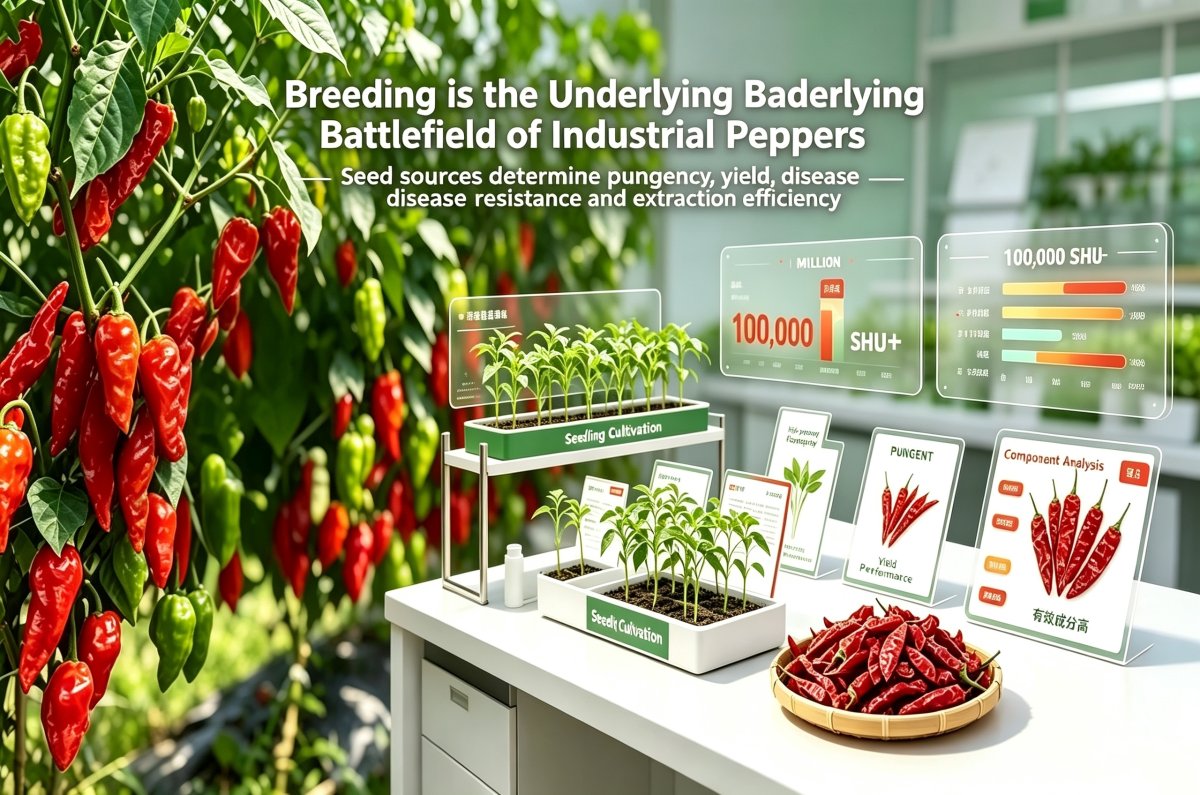
Trend 6: Breeding Is the Underlying Battlefield — Seed Stock Determines the Industry Ceiling
The final trend, and also the most fundamental one — the importance of breeding is being re-recognized. Many people think competition in industrial chili is at the processing end, the extraction end, or the sales end. But in reality, the most fundamental competition is at the breeding end. Variety determines everything:
- Variety determines the heat ceiling — common chili peppers reach tens of thousands of SHU; industrial chili can reach 1 million, 1.5 million, even 2 million SHU.
- Variety determines yield — good varieties have 2-3 times the yield of common varieties.
- Variety determines disease resistance — disease-resistant varieties have lower planting risk, less pesticide use, and are greener.
- Variety determines active ingredient content — varieties with high capsaicin content have higher extraction efficiency and lower cost.
Seed stock is the “chip” of the industrial chili industry.
In the past, most industrial chili varieties in China were imported from abroad or improved from local varieties; there were few truly independently bred high-heat varieties. But now, this situation is changing.
A group of domestic breeding experts have been deeply engaged in industrial chili variety breeding for 20-30 years. For example, Professor Xu Huashun, who specializes in industrial chili breeding, has developed industrial chili varieties with heat stably above 1,000,000 SHU, with some lines reaching 1,500,000 SHU — both disease resistance and yield have reached industry-leading levels.
Breeding breakthroughs are “changing the engine” for the entire industry.
With good varieties, the planting side can achieve high and stable yields; the processing side can supply stably; the extraction side can reduce costs; and downstream customers can receive raw materials of consistent quality. That’s why forward-thinking companies in the industry are all positioning at the breeding end — collaborating with research institutes, establishing breeding bases, and protecting seed stock resources. Whoever controls the seed stock controls the future of the industry.
Conclusion: What Will the Next Decade of Industrial Chili Be About?
Looking back at these six major trends, you’ll notice they all point in the same direction:
The industrial chili industry is shifting from “resource-driven” to “technology-driven,” from “fragmented competition” to “concentrated competition,” and from “agricultural product logic” to “industrial product logic.”
In the past, a company’s core competitiveness was “I have bases,” “I have supply sources.” Now, core competitiveness has become “I have varieties,” “I have technology,” “I have the full industry chain.”
For downstream customers, the criteria for choosing suppliers are also changing:
- No longer just looking at price — because losses caused by unstable heat are far greater than any price difference.
- No longer just looking at single products — because a full-product-line supplier saves you a lot of communication and management costs.
- No longer just looking at the present — because a partner who can supply stably and continue R&D is a true asset.
Jinda Capsaicin Technology Sichuan Co., Ltd. is an industrial chili full-industry-chain enterprise that has grown up against this industry backdrop.
We have core varieties bred by Professor Xu Huashun, and a complete product line from seedlings, fresh chili, dried chili, chili sauce, chili powder, to oleoresin capsicum, high-purity capsaicin, capsanthin, and chili meal.
The next decade of industrial chili is the decade of technology, the decade of the full industry chain, and the decade of domestic substitution. If you’re also looking for a reliable strategic partner in industrial chili, we’d love to talk.