
The pungency, color, and nutritional quality of pepper fruit are jointly determined by a variety of metabolites. However, the spatial distribution of these metabolites in different tissues and their dynamic changes have long lacked systematic analysis.
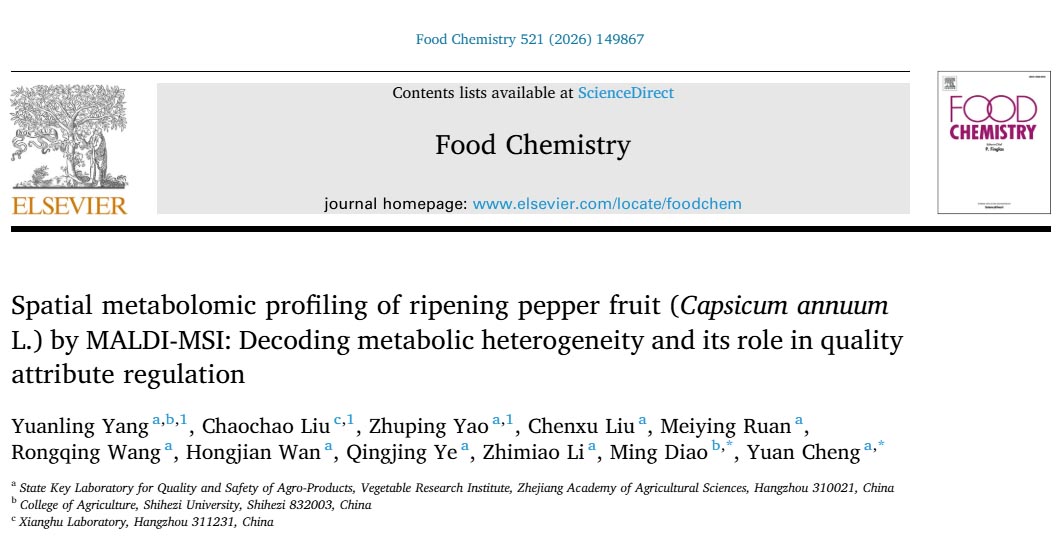
Recently, a research team led by Researcher Cheng Yuan from the Institute of Vegetables, Zhejiang Academy of Agricultural Sciences, in collaboration with Shihezi University and other institutions, published a research paper in Food Chemistry titled “Spatial metabolomic profiling of ripening pepper fruit (Capsicum annuum L.) by MALDI-MSI: Decoding metabolic heterogeneity and its role in quality attribute regulation.”
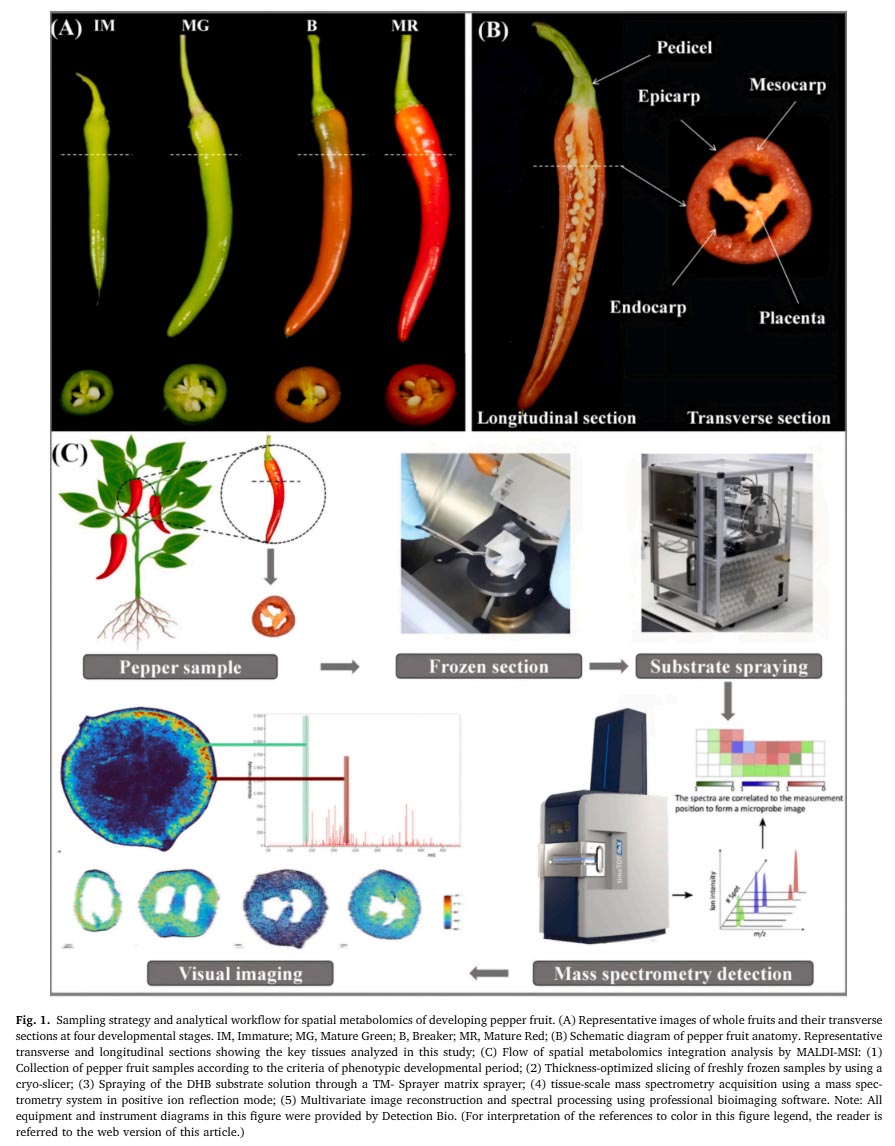
Using matrix-assisted laser desorption/ionization mass spectrometry imaging, also known as MALDI-MSI, the study systematically mapped the tissue-scale spatial distribution of 19 key metabolites across four developmental stages of pepper fruit at a spatial resolution of 50 μm. The study revealed spatial modularization and developmental-stage-dependent rearrangement patterns of metabolic pathways related to pungency, color formation, and nutritional quality.
Pungent Compounds Show a “Double-Peak Accumulation” Pattern in the Placenta, Rather Than a Simple Linear Increase
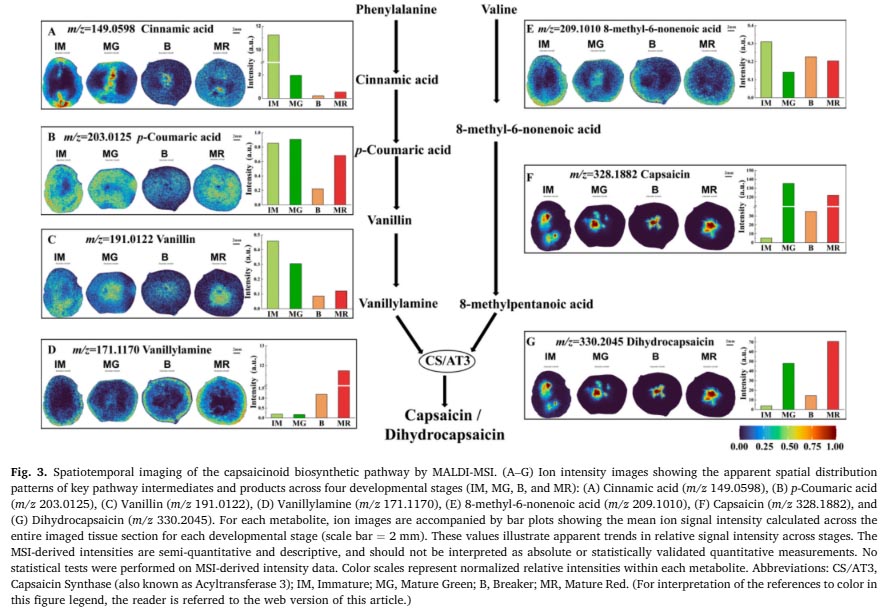
Capsaicin and dihydrocapsaicin, the characteristic compounds responsible for pungency, showed MALDI-MSI signals strictly limited to the placental tissue. This confirms that the placenta is not only a storage site, but also the main synthesis region for pungent compounds.
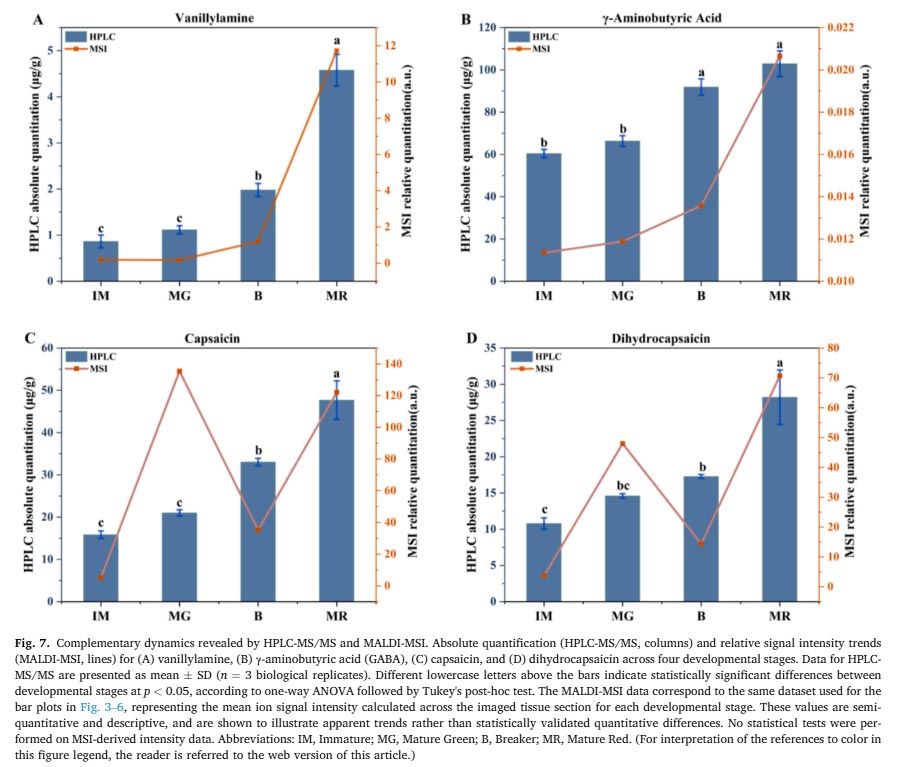
Interestingly, the relative signal intensity of capsaicinoids in the placenta displayed a “double-peak pattern,” with two peaks appearing at the mature green stage and mature red stage, while the signal decreased markedly during the color-breaking stage.
In contrast, whole-fruit homogenate quantification by HPLC-MS/MS showed that the absolute content of capsaicin continued to increase throughout fruit development.
This seemingly contradictory result actually reflects the fundamental difference between the two techniques. HPLC-MS/MS measures the total accumulated storage amount in the whole fruit, and capsaicin is chemically stable and hardly degrades. MALDI-MSI, on the other hand, reflects the “accessible metabolite pool” on the tissue surface that can be desorbed by the laser.
The “dip” in MSI signal during the color-breaking stage may result from the combined effects of biological compartmentalization and matrix ion suppression. Newly synthesized capsaicin may be secreted into deeper subepidermal cavities of the placenta, reducing surface accessibility. At the same time, large amounts of flavonoids and carotenoids during the color-breaking stage may co-crystallize and interfere with ionization.
This finding reminds us that overall content and local spatial dynamics may not always change in parallel. Spatial imaging provides a unique perspective for understanding the true distribution of metabolites.
Color Formation: Capsanthin Precursors Shift from Uniform Distribution to Pericarp Enrichment and May Be Redistributed Toward the Placenta
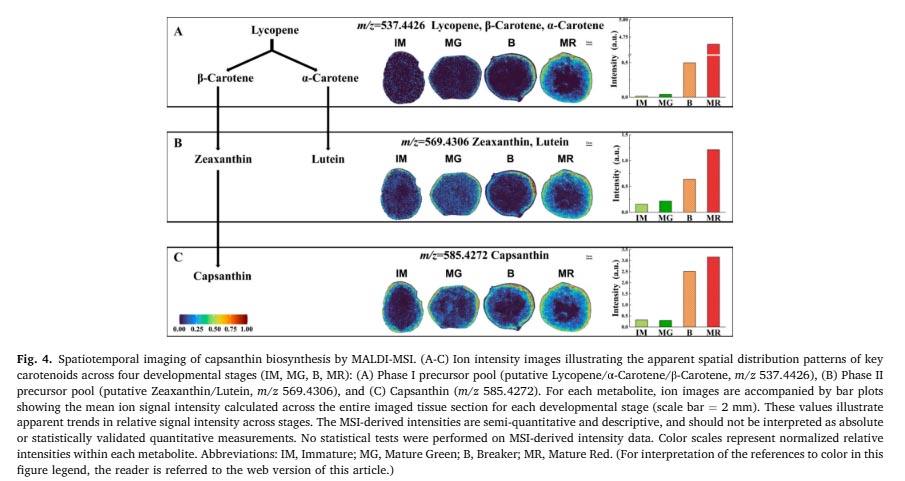
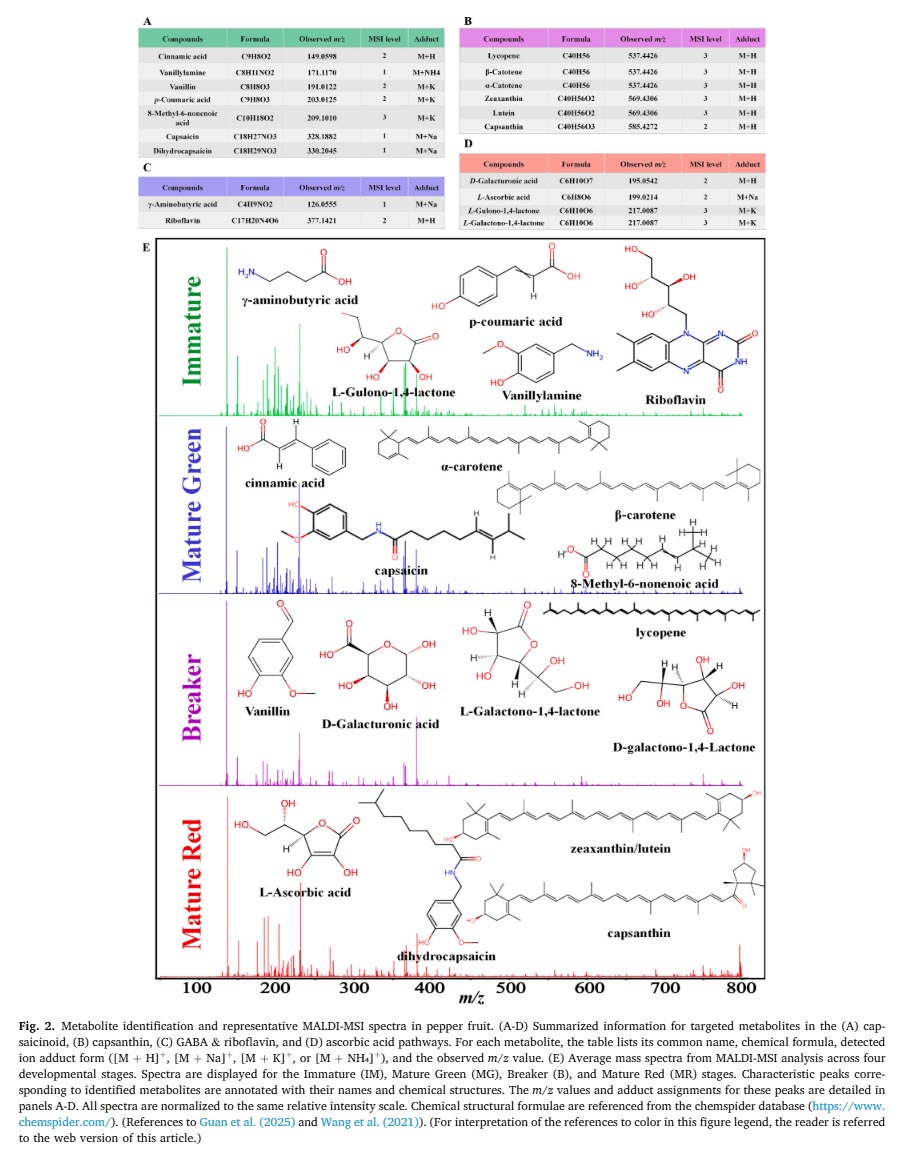
Capsanthin is the major pigment in mature red pepper fruit. The study divided carotenoid precursors into two functional modules: the Phase I precursor pool, including lycopene, α-carotene, and β-carotene, and the Phase II precursor pool, including zeaxanthin and lutein.
Imaging results showed that Phase I precursors shifted from uniformly low signals at the immature stage to specific accumulation in the pericarp at the mature green stage. By the color-breaking stage, the signal in the outer pericarp was further enhanced, while signals in the mesocarp and inner pericarp were clearly depleted. This suggests rapid spatial redistribution of precursors toward the outer fruit layers.
Phase II precursors initially appeared in the exocarp and gradually expanded inward during maturation, reaching a peak in the mesocarp at the mature red stage.
The final product, capsanthin, showed the strongest signal in the pericarp at the mature red stage. Notably, a weak but clear capsanthin signal was also detected in the placenta. Since capsanthin synthesis mainly occurs in the pericarp, the signal in the placenta may reflect apoplastic diffusion or inter-tissue redistribution. This suggests that capsanthin may be transported into internal tissues at the late ripening stage and participate in antioxidant defense for seeds.
Ascorbic Acid: Spatial Decoupling Between Synthesis and Distribution
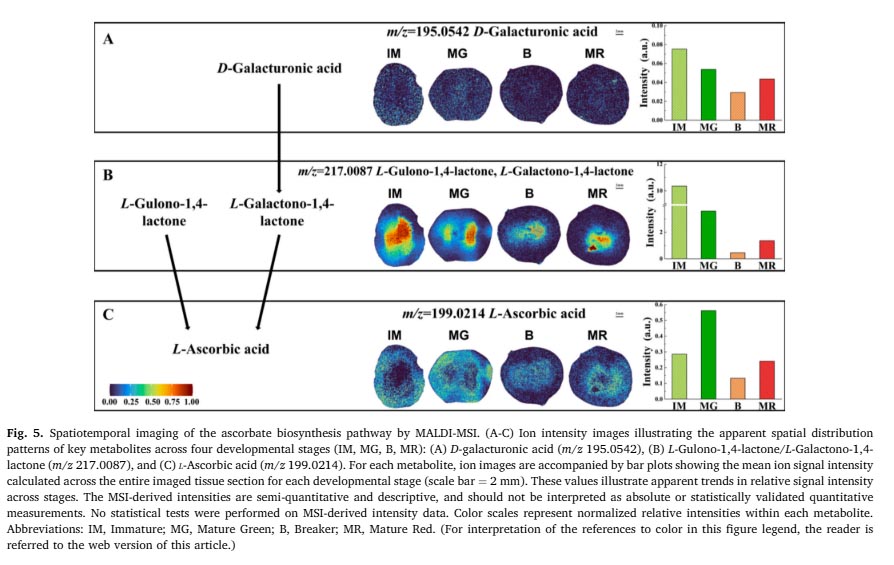
Ascorbic acid, also known as AsA, is an important nutritional antioxidant. The study found that its direct precursor lactone intermediates, including L-gulono-1,4-lactone and L-galactono-1,4-lactone, were merged as a putative lactone pool due to their isomeric nature. This lactone pool was significantly enriched in the placenta, and its signal decreased during development.
In contrast, the final product AsA was uniformly distributed at the early stage, reached its peak at the mature green stage, then declined, and became highly concentrated again in the placenta at the mature red stage.
Spatial correlation analysis showed that the global Pearson correlation coefficient between the lactone pool and AsA was only r = 0.22, significantly lower than the tight precursor-product coupling observed in other metabolic pathways.
This temporal and spatial decoupling between “synthesis in the placenta” and “distribution in the pericarp” strongly suggests that AsA may be synthesized in the placenta and then transported to other tissues. At the mature red stage, AsA may return to the placenta to provide more concentrated antioxidant protection for seed development.
The authors emphasized that this transport hypothesis still needs to be verified through future tracing experiments.
GABA and Riboflavin: Global Supply and Stage-Specific Relocation
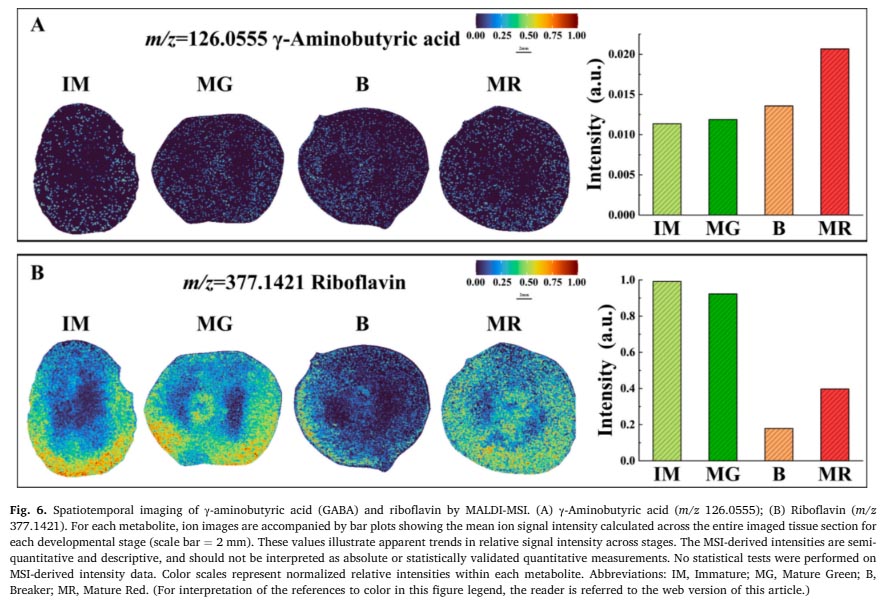
GABA was uniformly distributed across all tissues, and its relative signal continuously increased during ripening, rising by 82% at the mature red stage compared with the immature stage. This suggests a global strategy related to carbon-nitrogen balance and oxidative stress alleviation. This pattern is in sharp contrast to tomato, where GABA decreases in the late stage as metabolism shifts toward sugar accumulation.
Riboflavin, also known as vitamin B2, was concentrated in the pericarp at the immature stage and migrated toward the placenta at the mature green stage, possibly supporting seed embryo development. During the color-breaking stage, its signal dropped sharply by 81%, likely because its precursors were massively diverted into carotenoid and flavonoid pathways. At the mature red stage, riboflavin rebounded by 2.2-fold and returned to a uniform distribution pattern, possibly in response to a burst of reactive oxygen species during senescence.
This dynamic relocation reflects the functional switching of metabolites at different developmental stages.
Spatial Correlation Reveals a “Placental Core Synthesis Cluster” and a “Pericarp Precursor Pool”
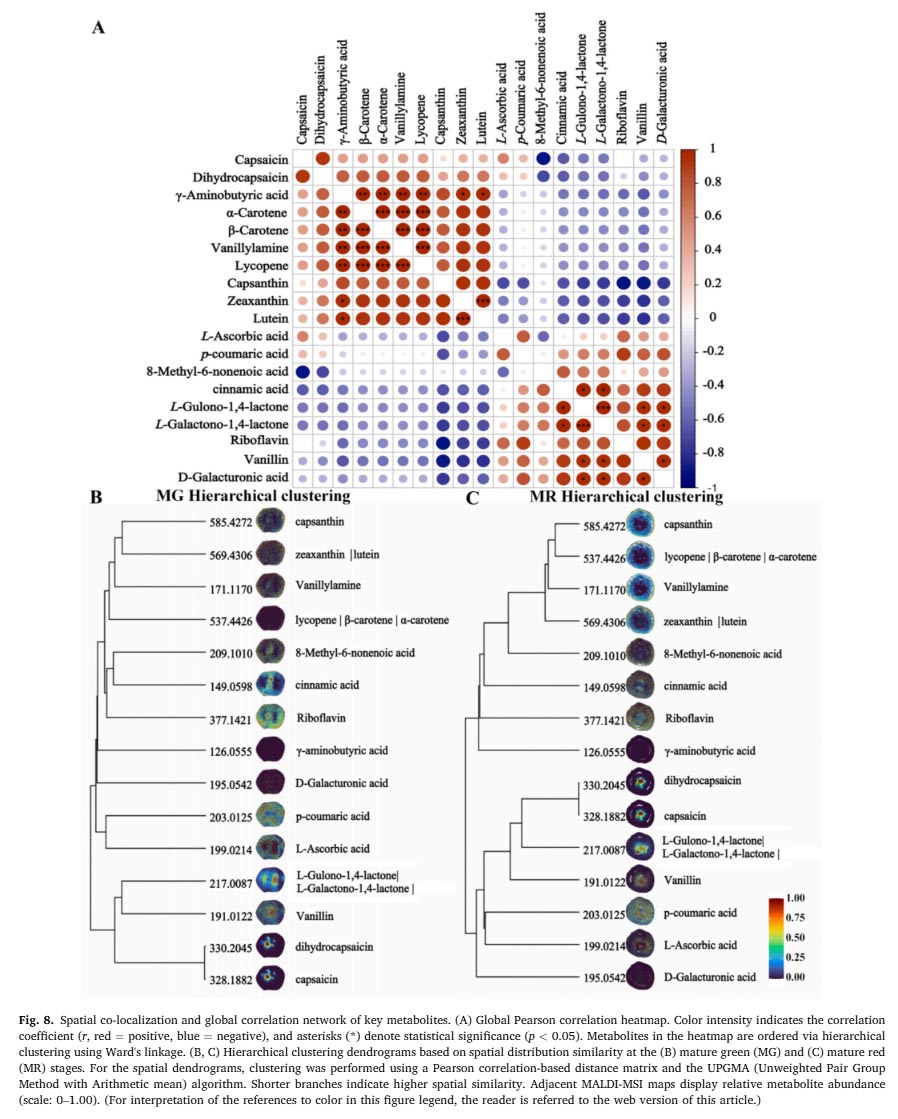
Through global Pearson correlation analysis and hierarchical spatial clustering, the study identified two major spatial modules.
The first was a “placental core synthesis cluster,” in which capsaicin, dihydrocapsaicin, vanillin, and the ascorbic acid lactone pool were highly co-localized.
The second was a “pericarp precursor pool,” in which vanillylamine, 8-methyl-6-nonenoic acid, capsanthin, and carotenoid precursors such as lycopene and zeaxanthin were co-localized. Their correlations were extremely strong, with the correlation between capsanthin and zeaxanthin reaching r = 0.95.
These results indicate that pungency and pigment pathways may share precursor resources at the sub-tissue level, while ascorbic acid metabolism exhibits independent spatial regulation.
Methodological Highlights and Complementarity
This study combined MALDI-MSI, which provides spatial imaging from single sections at different developmental stages, with HPLC-MS/MS, which provides absolute quantification based on three biological replicates.
For uniformly distributed metabolites, such as GABA and vanillylamine, the two methods showed consistent trends.
For spatially heterogeneous metabolites, such as capsaicinoids, the two methods revealed different but complementary dynamics. HPLC-MS/MS showed continuous whole-fruit accumulation, while MSI revealed local fluctuations in the placenta.
This difference is not a contradiction. Rather, it reflects the distinct characteristics of the two technologies and highlights the necessity of combining spatial imaging with overall quantitative analysis to fully understand metabolic regulation.
Statement: The information is sourced from industry-related pepper research. If there is any infringement concern, please contact us for removal.