Since its introduction to China in the late 16th century, the chili pepper has evolved over more than four centuries from an exotic ornamental plant into an indispensable condiment and vegetable on Chinese dining tables, as well as a vital pillar industry supporting China’s agricultural economy. Recently, a team led by Academician Zou Xuexiao from Hunan Agricultural University published a review article titled “The Capsicum Industry in China: Development and Impact” in the Horticultural Plant Journal. The paper systematically outlines the historical evolution, production landscape, consumption patterns, economic value, and global competitiveness of China’s chili pepper industry, while also offering a perspective on its future development.
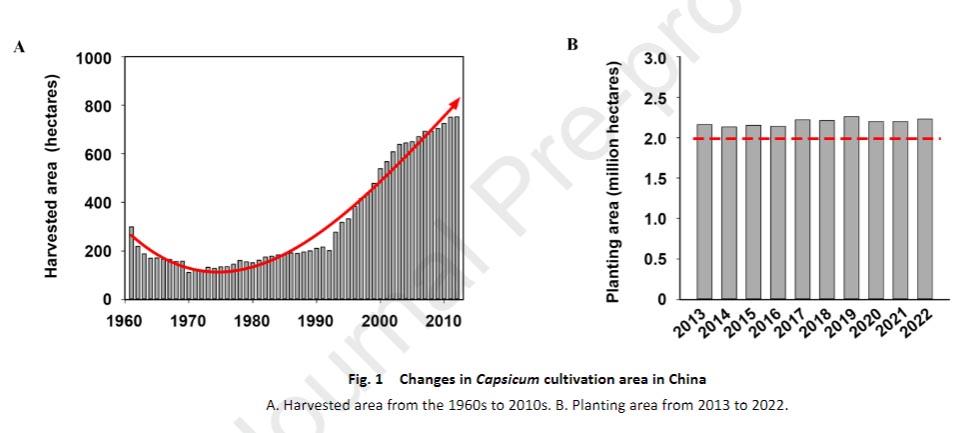
This review notes that chili peppers were first recorded in Chinese literature in 1591, having been introduced to Zhejiang via maritime trade routes. After a long period of being cultivated primarily for ornamental purposes, chili peppers gained rapid acceptance in humid regions—such as Hunan, Guizhou, and Sichuan—due to their pharmacological properties of “dispelling dampness and cold.” By the 18th century, they had become a key condiment; by the late 19th century, distinct regional patterns of spiciness had emerged: a “high-spiciness zone” centered on the middle and upper reaches of the Yangtze River, a “medium-spiciness zone” extending northward, and a “low-spiciness zone” along the southeastern coast. Since the 20th century, driven by the growth of domestic trade and advancements in cultivation technology, the chili industry has evolved from producing local specialties to large-scale commodities, shifting from seasonal availability to year-round supply. Notably, since the 1980s, the cultivation area has surged from under 200,000 hectares to over 500,000 hectares in 2000, stabilizing at more than 2.25 million hectares by 2023. With an annual output exceeding 64 million tonnes—accounting for 44.7% of global production—chili peppers have become the vegetable crop with the largest cultivation area in China.
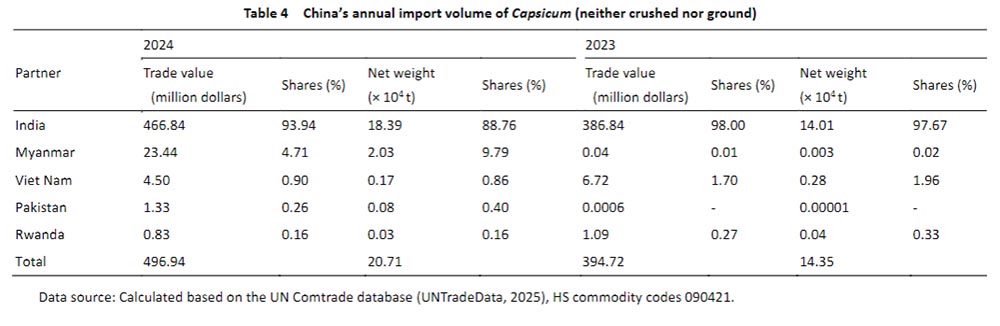
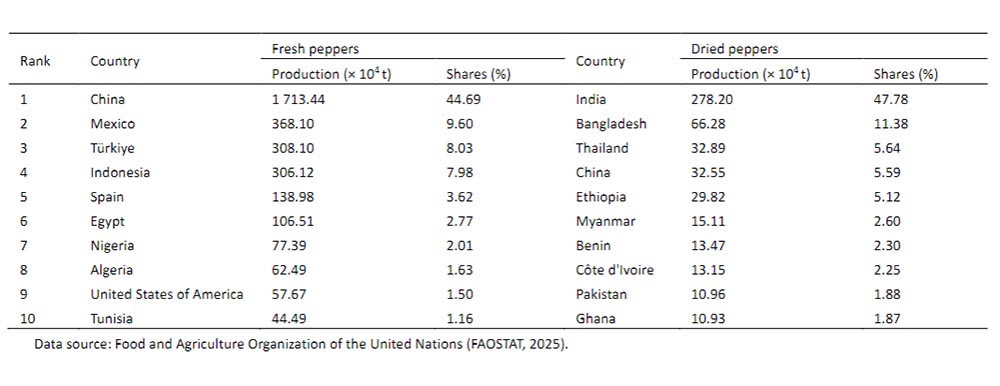
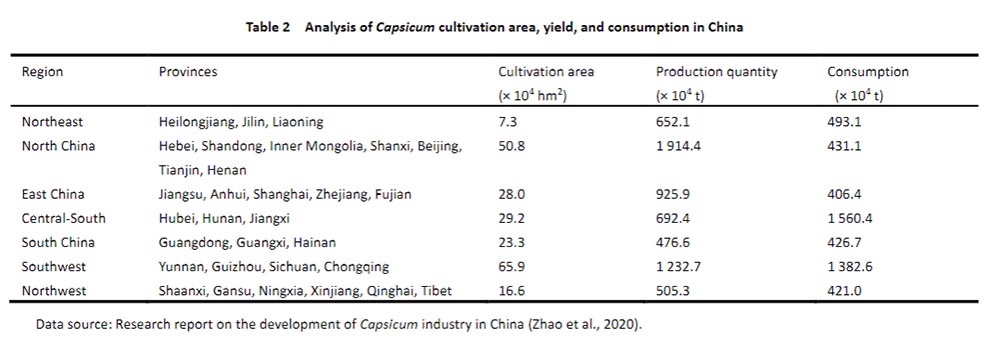
China’s chili industry has developed a highly integrated value chain: the upstream market for seeds and seedlings is valued at 24–35 billion RMB annually; the midstream sector—fresh chili cultivation—generates an output value of approximately 120–130 billion RMB; and the downstream processing industry encompasses products such as chopped chili, chili sauce, spicy snacks, and chili oleoresin, generating tens of billions of RMB in annual value. This sector also drives the trillion-yuan catering industry (featuring cuisines like Hunan and Sichuan) and specialized tourism initiatives such as “Chili Towns.” Production is geographically concentrated: the North, Northwest, and Northeast regions contribute nearly 48% of total output, while the Southwest accounts for 19%; production volumes are lower in Central, East, and South China. Protected cultivation (including plastic tunnels and greenhouses) now accounts for 26% of the total area, enabling year-round supply. While China holds an absolute advantage in the fresh chili sector (44.7% of the global total), India leads in the dried chili sector with a 47% global share, whereas China ranks fourth (5%). In terms of trade, China primarily exports dried chili peppers and processed products while simultaneously importing large quantities of high-pungency dried chilies from India for extraction and processing; in 2024, Indian supplies accounted for 93.9% of the value of China’s imports of whole dried chili peppers.
China’s chili pepper industry currently faces challenges such as significant varietal homogeneity, high labor costs (comprising 20%–40% of production costs), and low levels of mechanization, creating an urgent need to shift from scale-based expansion to efficiency enhancement. The review suggests that future efforts should focus on breeding specialized varieties, advancing mechanized production, and deepening the processing value chain to withstand fierce competition from countries like India and to consolidate China’s global position in the chili pepper sector.