
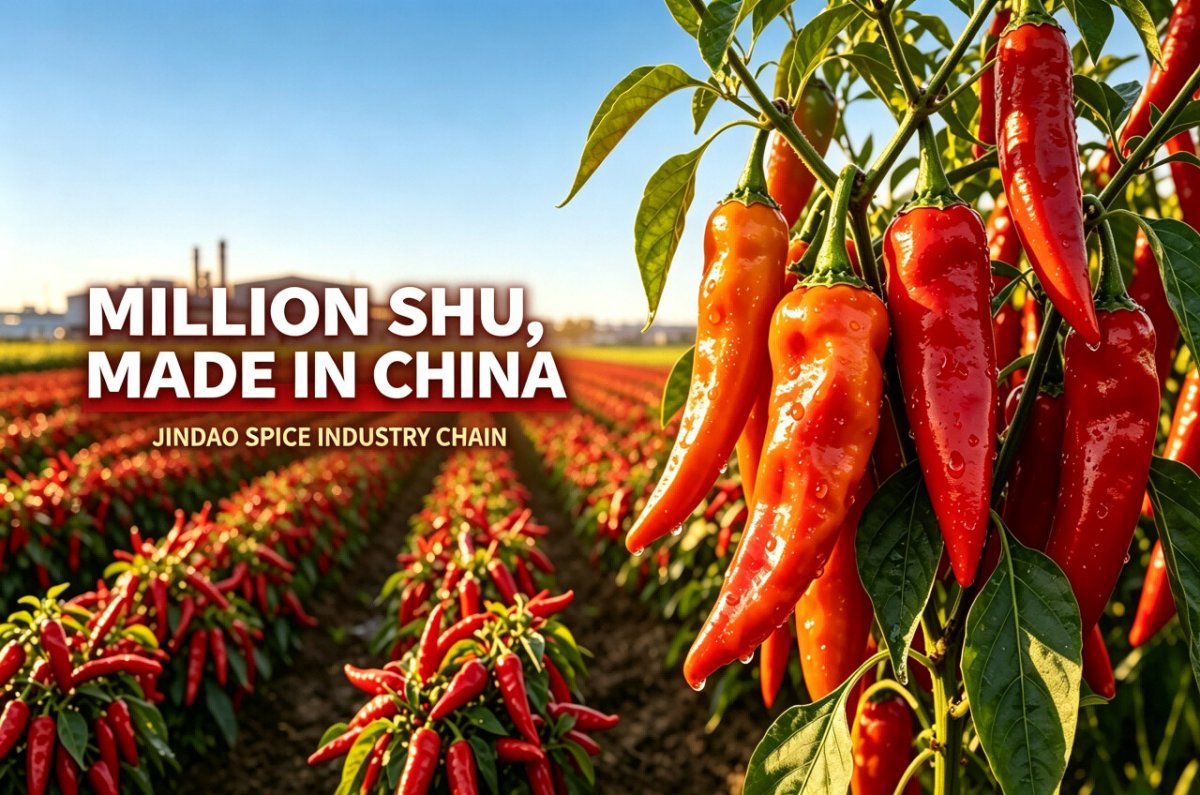
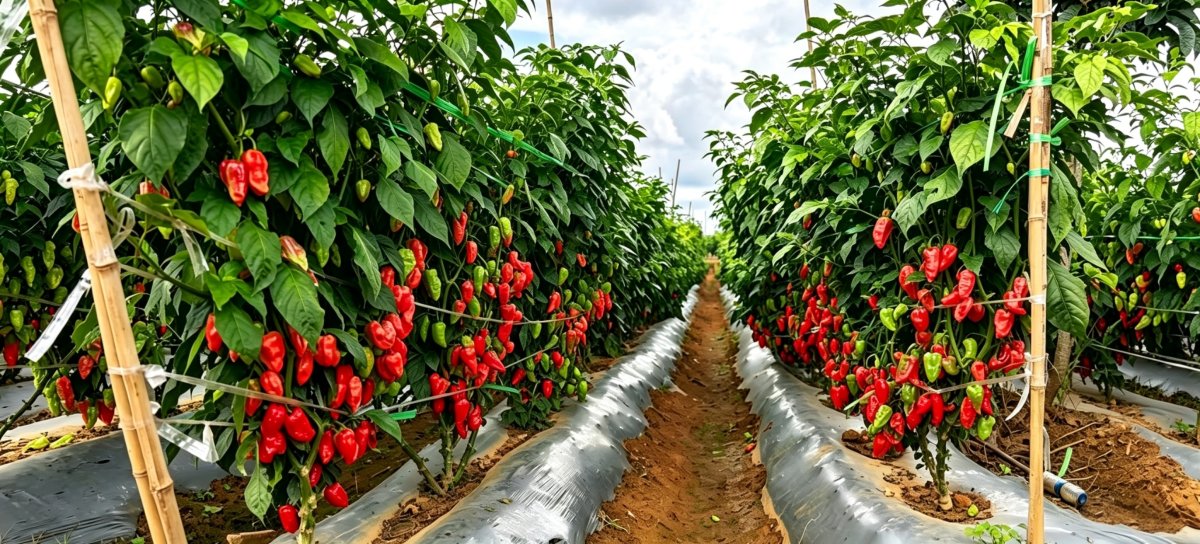
Across China, industrial chili peppers are entering their concentrated harvest season. In the hilly regions of Sichuan, the mountainous areas of Yunnan, and the Gobi Desert of Xinjiang, vast fields of Jindao No. 1 industrial chili peppers hang heavy on branches—their bright red fruits spreading across the landscape like a vivid tapestry of the red industry.
Unlike the edible chili peppers used in hot pot and stir-fries, this variety reaches an astonishing 1 million SHU (Scoville Heat Units)—10 to 20 times hotter than ordinary millet peppers—and cannot be eaten directly. Its value lies not on the dining table, but in the factory: after drying and extraction, it yields high-purity natural capsaicin, oleoresin capsicum, and capsanthin (paprika red pigment). These are widely used in high-end industrial sectors such as topical pharmaceutical preparations, biological insect repellents, natural color pigments for cosmetics, security equipment, and marine antifouling coatings—making them indispensable core raw materials in the green biomanufacturing sector.
In recent years, the domestic industrial chili pepper sector has been gaining momentum. For a long time, China relied heavily on imports from India for high-purity natural capsaicin raw materials. Fluctuations in international raw material prices, instability in cross-border supply chains, and significant quality variations between batches have long plagued domestic downstream processing enterprises. When overseas producing regions experience abnormal weather or reduced yields, domestic capsaicin procurement costs surge sharply, and many enterprises face the risk of supply disruptions.
Against this industrial backdrop, domestic high-pungency industrial chili peppers and the native capsaicin extraction industry are embracing tremendous growth opportunities. Jindao Capsaicin Technology is a representative full-industrial-chain enterprise rooted in this import-substitution track. Leveraging independently bred varieties, nationwide multi-region raw material sourcing, standardized contract farming, and advanced deep-processing extraction technology, Jindao Capsaicin is reshaping the landscape of China’s industrial chili and natural capsaicin industry.
I. Superior Seeds as the Foundation: Jindao No. 1—A Super Chili Variety Built for Industrial Extraction
Industrial development begins with the variety.
Many regions developing the industrial chili industry simply introduce foreign varieties, which often suffer from poor adaptability, weak disease resistance, unstable yields, and fluctuating pungency levels. Unstable pungency directly affects the yield of subsequent extraction processing—if one year yields 1 million SHU and the next only 800,000, production line parameters must be adjusted accordingly, imposing significant cost losses on downstream manufacturing enterprises.
Jindao Capsaicin has been deeply engaged in industrial chili breeding for many years. Its core variety, Jindao No. 1, is a high-pungency industrial specialty variety improved and bred for multi-regional climates across China by Professor Xu Huashun and his team.
Core advantages of Jindao No. 1:
- Stable pungency: Consistently exceeds 1 million SHU; 3C hybrid varieties can reach over 1.5 million SHU with minimal batch-to-batch variation
- Strong disease resistance: Reduces farmers’ planting risks and lowers pesticide use
- Wide adaptability: Thrives in multiple provinces including Yunnan, Guizhou, Sichuan, Hunan, Hubei, Xinjiang, and Guangxi
- Long harvest window: Concentrated harvest from July to October, with multiple picking batches
- High enrichment: High capsaicin enrichment in peel and seeds, making it more suitable for industrial extraction with higher raw material utilization than traditional imported varieties
To ensure standardized planting practices, Jindao Capsaicin has developed a complete standardized planting technology system. Uniform technical specifications cover every stage—from seedling cultivation, land preparation, and transplanting to water and fertilizer management, pest and disease control, batch harvesting, and field sorting. The company has established a professional agricultural technical service team, dispatching technicians to partner villages and towns to conduct on-site training and field management guidance, ensuring that superior seeds are paired with superior cultivation methods.
Many farmers initially have concerns about industrial chili peppers: They’re so hot—can we even grow them? Who will buy them? Will the price drop?
Jindao Capsaicin implements a “company + village collective + farmers” contract farming model. Partnering farmers receive unified seedling provision and full technical guidance from the company, along with guaranteed minimum-price purchase agreements. Once the chilies mature, the company purchases fresh and dried chilies on-site, locking in purchase prices in advance and eliminating farmers’ risk of “bountiful harvest without income.” Farmers don’t need to worry about sales channels or bear market price fluctuation risks—they only need to follow the standardized plan for field management and earn stable planting income.
Compared with traditional crops like corn and rice, Jindao No. 1 industrial chili peppers significantly increase per-mu income, making them a high-quality specialty cash crop for rural industrial revitalization.
Currently, Jindao Capsaicin’s nationwide industrial chili planting footprint reaches 200,000 mu (approximately 13,333 hectares), with three core raw material bases in Hainan, Yunnan, and Guangxi operating simultaneously. This multi-base layout disperses climate disaster risks, ensures stable year-round raw material supply, and avoids supply disruptions caused by disasters in a single producing region—one of the core advantages of Jindao Capsaicin’s supply chain system.
II. Full Industrial Chain Closed Loop: From Fresh Field Chilies to High-Purity Capsaicin—Connecting Every Link of the Industry
A common pain point in China’s industrial chili industry today is that many projects remain at the planting stage, lacking primary processing at origin and deep extraction capacity. Many regions only grow chilies and ship them long distances after harvest, resulting in high fresh chili losses and transportation costs. Meanwhile, without deep processing capabilities, they can only sell primary dried chilies with very low industrial added value, and most profits leak away. When market conditions change, unsold inventory easily accumulates, leaving the industry with weak risk resistance.
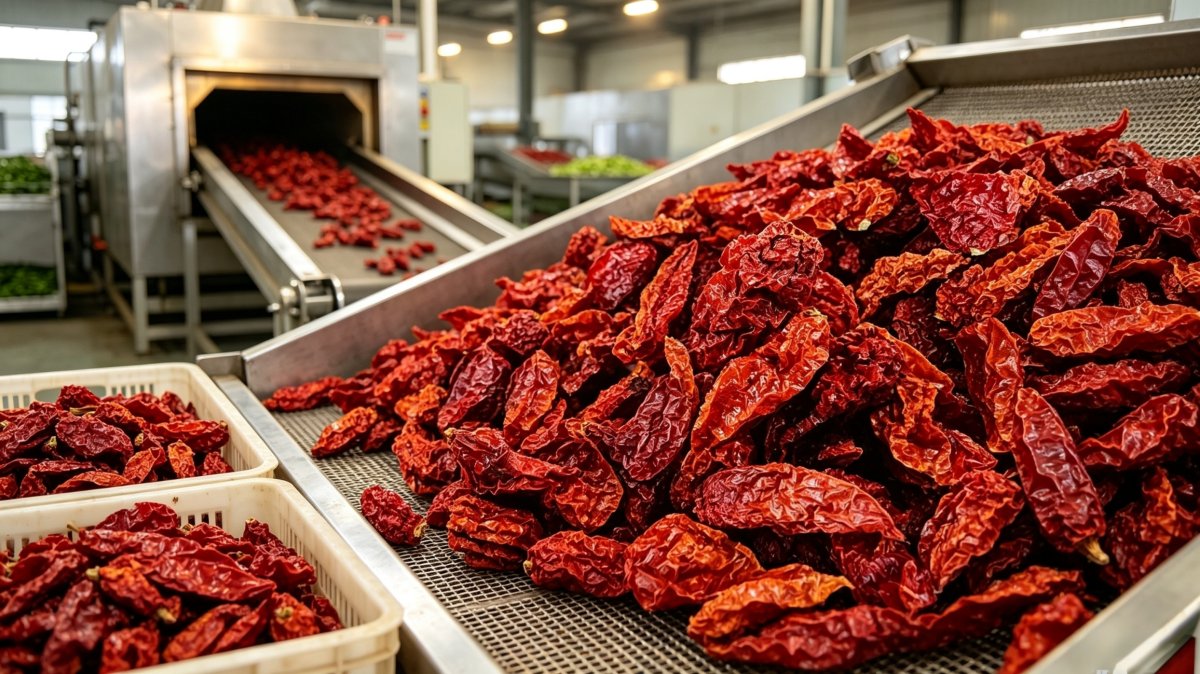
Jindao Capsaicin’s core competitiveness lies in its complete full-industrial-chain closed loop: variety breeding → scaled contract planting → on-site sorting and drying for primary processing → supercritical extraction for deep processing → customized supply of finished capsaicin products. Drying, sorting, and primary processing stations are built near raw material bases. After fresh chilies are picked, they undergo sorting, impurity removal, and drying at origin immediately—significantly reducing fresh chili spoilage losses (fresh chili transportation losses typically reach 20%–30%), cutting long-haul transportation costs, and ensuring stable raw material quality.
In deep processing, Jindao Capsaicin employs advanced extraction processes and technologies, with standardized extraction factories. Relying on its in-house R&D laboratory and professional R&D team, the company stably produces six major product lines.
In terms of supply model, Jindao Capsaicin has innovatively launched a pre-order supply scheme. Under the traditional capsaicin procurement model, downstream enterprises need to stockpile large quantities at once to ensure production, tying up substantial working capital while bearing storage losses and raw material quality degradation risks. Under the pre-order model, downstream manufacturers don’t need to stockpile heavily—they sign supply plans in advance, and the company delivers continuously and stably according to production schedules, greatly reducing downstream customers’ capital pressure while ensuring continuous and stable raw material supply.
Currently, Jindao Capsaicin products have established partnerships with multiple industry-leading enterprises, with applications spanning multiple sectors:
- Pharmaceutical field: High-purity capsaicin used in topical analgesic preparations
- Agricultural field: Natural capsaicin made into eco-friendly biological insect repellents, replacing some chemical pesticides—green and pollution-free
- Daily chemical and cosmetics field: Capsanthin as a natural colorant
- Specialty fields: Capsaicin used in security products, marine antifouling coatings, cable rodent and bird repellent materials, etc.
The continuously expanding demand for natural biological raw materials opens up long-term growth space for Jindao Capsaicin.
III. Amid the Industrial Chili Boom: Opportunities and Risks Coexist
As the economic benefits of industrial chili peppers gain widespread attention, many regions across China have seen a surge in industrial chili planting over the past two years. Many areas have jumped on the bandwagon, but the hidden risks behind the industry cannot be ignored.
First, variety risk. Some projects blindly introduce foreign varieties without localized trial planting. The varieties have poor adaptability, and yields and pungency fall short of expectations—ultimately the raw materials fail to meet the procurement standards of processing enterprises.
Second, contract performance risk. Some projects only promote high returns without genuine guaranteed-price purchase orders. Farmers expand planting blindly, and after a bumper harvest, no one comes to buy—resulting in “bountiful harvest with unsold inventory.”
Third, industrial chain is risk. With only planting and no primary or deep processing, producers can only sell primary dried chilies at low prices with low added value and weak resistance to market price fluctuations.
Fourth, raw material quality risk. Scattered smallholder farming lacks standardized technical guidance, resulting in uneven chili pungency that affects subsequent extraction processing efficiency.
Industry experts point out that industrial chili peppers are not a “universal wealth-building crop.” Stable superior varieties, standardized planting, reliable guaranteed-price purchase orders, and supporting processing capacity—all four are indispensable. Relying solely on expanding planting area makes it difficult to achieve sustainable industrial development. A controllable full industrial chain is the core logic for the long-term healthy development of the industrial chili industry.
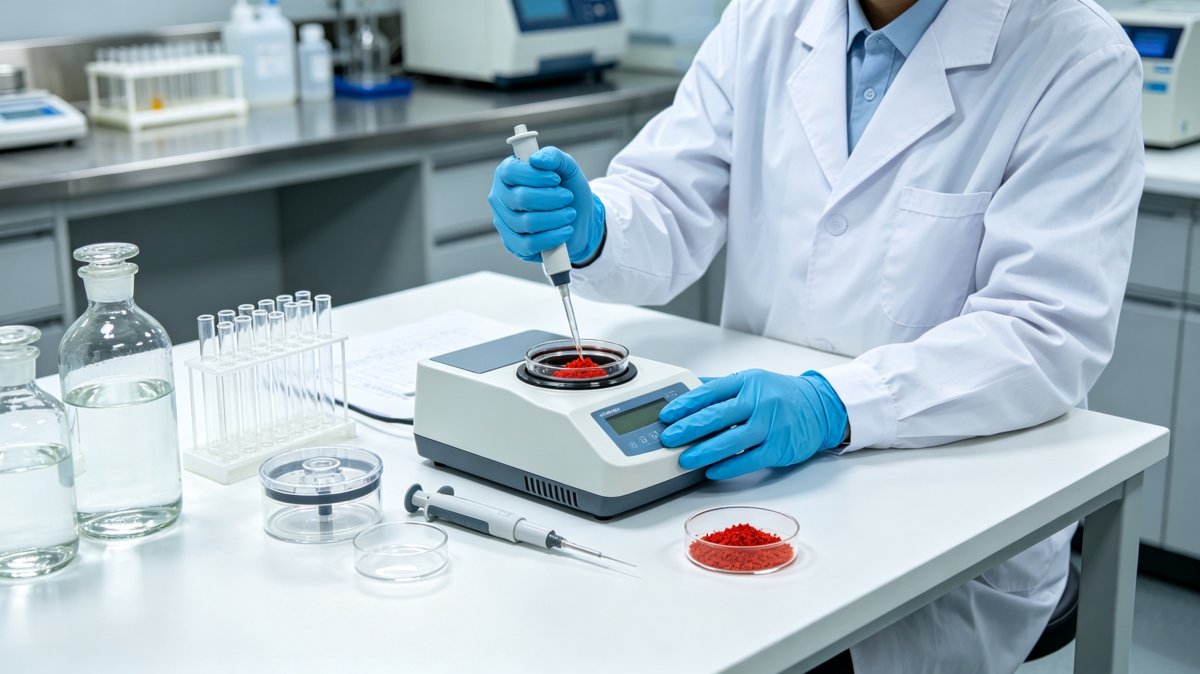
In its industrial layout, Jindao Capsaicin has always adhered to production driven by sales, and does not blindly expand planting scale. Before each base is established, downstream orders are locked in first, then farmer planting is developed—using orders to underpin the planting side. At the same time, the company continuously improves on-site primary processing, deep processing, and R&D testing capabilities, embedding quality control throughout the entire chain from field to finished product. Every batch of raw materials and every batch of capsaicin finished products undergo laboratory testing to ensure stable and controllable pungency and purity indicators.
While driving income growth for rural farmers, Jindao Capsaicin also provides domestic manufacturing with stable, cost-effective domestic natural capsaicin raw materials, reducing dependence on overseas imported raw materials. Jindao Capsaicin is realizing the dual release of agricultural value and industrial new material value. During base development, the company also continuously drives rural employment—creating numerous local labor positions in harvesting, sorting, and drying, revitalizing idle land resources, and transforming the land resource advantages of mountainous and hilly areas into specialty biological industry advantages.
IV. The Era of Natural Extracts: Domestic Capsaicin Enters a Long-Term Growth Window
The global green biomaterials and natural additives industry is developing rapidly. Consumer and manufacturing preferences for naturally sourced raw materials continue to rise. Compared with synthetic capsaicin, market demand for natural capsaicin and natural capsanthin is growing steadily. Downstream industries such as pharmaceuticals, biopesticides, specialty materials, and cosmetics show long-term positive demand for high-quality natural capsaicin.
In August 2026, the U.S. Department of Commerce issued a final anti-dumping and countervailing duty ruling on oleoresin capsicum imported from India, with a combined tax rate exceeding 23%. This change in the international trade landscape further frees up market space for domestic capsaicin. In the past, Indian products dominated a large share of the international market with price advantages; today, under tariff barriers, Chinese enterprises’ cost-performance advantage has become even more prominent.
In the long run, the import substitution of domestic industrial chili peppers and natural capsaicin is an irresistible trend. Previously constrained by insufficient breeding capacity, backward large-scale planting levels, and extraction technology gaps, the domestic market was highly dependent on Indian raw materials. Now, with the rise of domestic full-industrial-chain enterprises represented by Jindao Capsaicin—with independent superior varieties are landed, multi-base large-scale planting, and mature domestic extraction technology—China’s natural capsaicin supply chain continues to strengthen its independent and controllable capabilities.
The future of the industry will no longer be about who has the larger planting area, but rather about variety R&D capability, full-chain quality control capability, stable supply capability, and applied technology R&D capability.
Going forward, Jindao Capsaicin will continue to increase investment in breeding and R&D, optimize the performance of Jindao No. 1, and expand more downstream application scenarios. The company will continuously improve its nationwide base layout and deepen the contract farming model. It will also keep optimizing extraction processes and increasing high-purity capsaicin production capacity.
A tiny red industrial chili pepper connects rural fields on one end and high-end biomanufacturing factories on the other. From the bright red fruits in the fields to high-purity capsaicin crystals in the laboratory, Jindao Capsaicin is using its full-industrial-chain model to drive China’s industrial chili industry beyond the extensive planting stage and toward a brand-new development phase of improved varieties, standardization, and refined deep processing.
The story of domestic capsaicin has only just begun.