
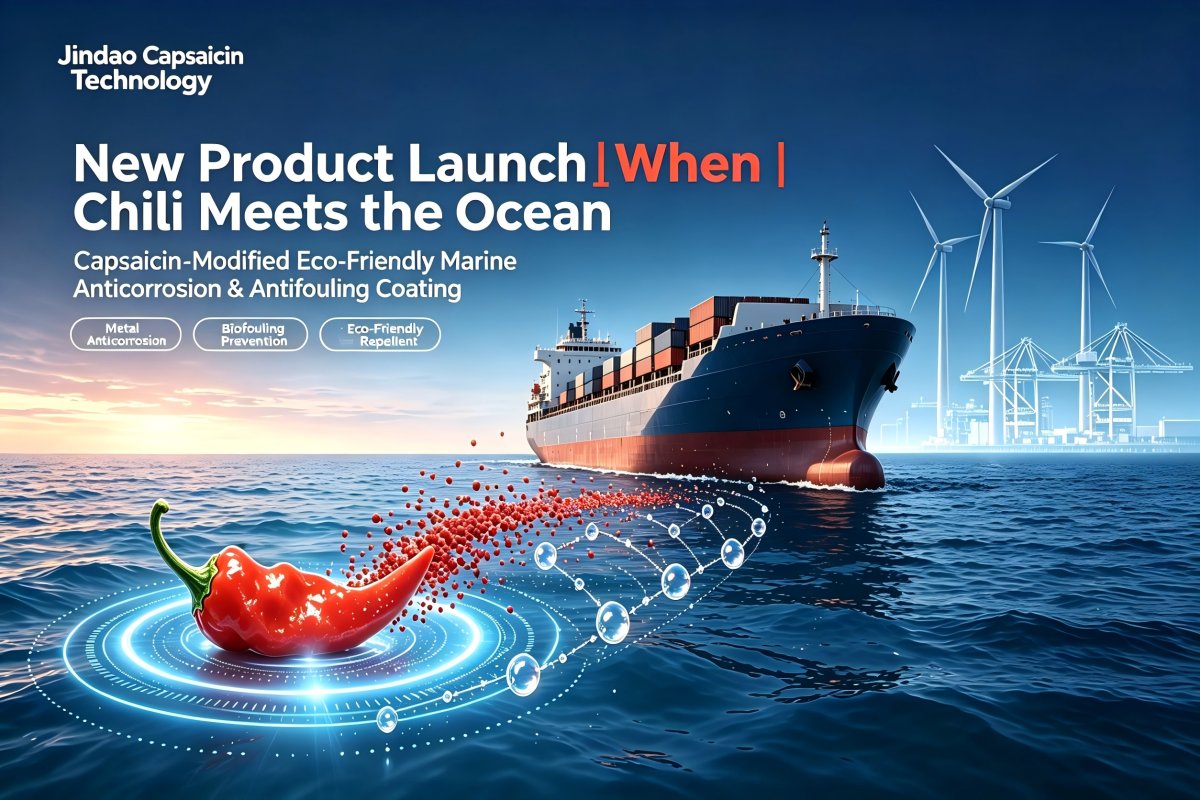
What can a chili do? It can be the soul seasoning on the dining table, an effective analgesic in the medical field, or a core raw material for security equipment. But what you may not expect is that it can also guard 10,000-ton giant ships as they sail across the vast deep blue ocean. Today, Jindao Capsaicin Technology officially launches its brand-new product line – capsaicin-modified eco-friendly marine anticorrosive and antifouling coating. Relying on 99.99% high-purity natural capsaicin modification technology, it achieves dual protection of metal anticorrosion and marine organism anti-adhesion at the same time, providing a more eco-friendly, efficient and economical protection solution for marine engineering equipment such as ships, offshore wind power facilities and coastal steel structures. This time, Jindao has expanded the value of chili to the blue ocean.
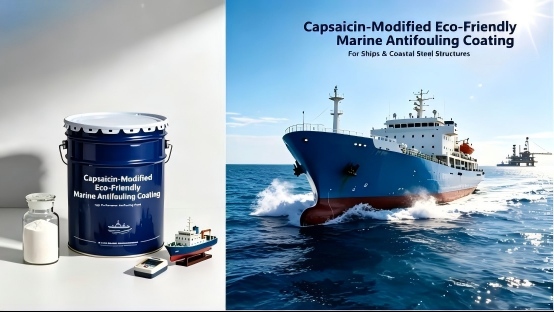
1. Why Is Marine Antifouling a Long-Standing and Intractable Problem?
Before introducing this product, let’s first talk about the pain points in the industry.
All ships sailing in the sea and equipment immersed in seawater cannot avoid a troublesome problem – marine organism adhesion.
Barnacles, shellfish, algae, moss… These seemingly insignificant marine organisms, once attached to the bottom of ships and the surface of marine facilities, will bring a series of troubles:
1. Soaring Sailing Resistance and Skyrocketing Fuel Costs
Marine organisms attached to the ship bottom will greatly increase the surface roughness of the hull, leading to a sharp rise in sailing resistance.
Data shows that if a layer of marine organisms with a thickness of only 1 mm adheres to the hull surface, the sailing resistance will increase by 15%-20%, and fuel consumption will increase by 10%-15%.
For a 10,000-ton ocean-going cargo ship, the annual fuel cost alone amounts to tens of millions or even hundreds of millions of yuan. A 10% increase in fuel consumption means an extra expenditure of millions or even tens of millions of yuan every year.
2. Regular Dock Cleaning Causes Huge Losses from Suspended Navigation
To solve the adhesion problem, the traditional approach is to regularly sail the ship into a dry dock, manually remove the attached organisms and repaint the surface.
A single dock stay takes at least ten days, or even a month. During this period, in addition to paying high dock repair costs, what is more important is – every day the ship is docked, it loses a day’s revenue.
For shipping enterprises, time is money. The loss from suspended navigation is often higher than the maintenance cost itself.
3. Traditional Antifouling Paints Face Increasing Environmental Pressure
In the past, the mainstream solution for marine antifouling was toxic antifouling paint – which poisons attached organisms by releasing toxic substances (such as organotin and copper compounds).
The effect is indeed good, but the cost is also huge:
- Polluting the marine ecology: Toxic substances accumulate in marine organisms and are transmitted through the food chain, ultimately endangering the entire marine ecosystem
- Increasingly strict regulations: The International Maritime Organization (IMO) has completely banned organotin antifouling paints, and restrictions on copper-based antifouling paints are gradually being tightened
- High post-maintenance costs: The treatment and recycling of toxic antifouling paints have strict environmental requirements, resulting in high costs
On one hand, there is the unavoidable demand for antifouling, and on the other hand, there are increasingly strict environmental requirements. The marine engineering industry is in urgent need of an antifouling solution that is both effective and eco-friendly.
This is the reason why Jindao Capsaicin entered the marine coating track.
2. Capsaicin Antifouling: A “Natural Solution” from Laboratory to Industrialization
Using capsaicin for marine antifouling is not a brand-new concept.
The scientific community discovered long ago that marine organisms are afraid of capsaicin.
Capsaicin is the main active component in chili. It causes a strong burning sensation in mammals, and also has a strong repellent effect on marine organisms. Marine attached organisms such as barnacles, shellfish and algae will actively avoid capsaicin after contact, and will not attach to surfaces coated with capsaicin.
This principle sounds simple, but it is far more difficult than imagined to actually develop a coating product with stable performance that can be applied industrially.
There are three core difficulties:
Difficulty 1: The purity of capsaicin must be high enough
Ordinary oleoresin capsicum has many impurities, dark color and strong odor. Adding it directly to the coating will affect the appearance and performance of the coating. High-purity capsaicin must be used – the higher the purity, the smaller the addition amount, the more stable the performance, and the smaller the impact on the coating system.
Jindao Capsaicin has the production capacity of 99.99% high-purity natural capsaicin, which is the basic prerequisite for producing capsaicin-modified coatings.
Difficulty 2: Capsaicin must be able to be “released slowly”
Antifouling coatings are not one-time products – after one application, they need to remain effective in seawater for 3-5 years. This requires that capsaicin must be uniformly dispersed in the coating system, and can be released slowly and continuously with seawater immersion, rather than being completely dissolved all at once.
If it is released too fast, it will fail in a few months; if it is released too slow, the antifouling effect will be insufficient. The precise control of the release rate is the key technology that determines the service life of the coating.
Through microcapsule coating technology and coating structure design, Jindao’s R&D team has achieved the controlled release of capsaicin, ensuring that the coating remains effective during long-term seawater immersion.
Difficulty 3: Capsaicin must be “compatible” with the coating system
Capsaicin is a natural organic compound. To make it perfectly compatible with coating resin systems such as acrylic, epoxy and polyurethane, without precipitation, migration, or affecting the adhesion and anticorrosive performance of the coating, a large amount of formula adjustment work is required.
After repeated tests, Jindao’s R&D team has overcome the compatibility problem. Capsaicin can be uniformly and stably dispersed in the coating system without affecting the various basic properties of the coating.
From high-purity capsaicin raw materials, to controlled release technology, and then to the coating formula system – the three core technologies are all indispensable.
Jindao Capsaicin is one of the few enterprises in China that masters all three technologies at the same time.
3. Four Core Advantages Redefine Marine Protection
What are the strengths of this capsaicin-modified eco-friendly marine anticorrosive and antifouling coating? We summarize it with four key words.
More Eco-Friendly: Modified with Natural Capsaicin to Guard the Blue Ocean
This is the core differentiated advantage of this product.
Traditional antifouling paints rely on toxic substances to poison marine organisms, while Jindao’s coating relies on the physical repellent mechanism of natural capsaicin.
- Repel rather than poison: Capsaicin only has a repellent effect on marine organisms, will not cause biological death, and does not damage the marine food chain
- Low toxicity and low leaching: Capsaicin is a natural plant extract, environmentally friendly, and can be naturally degraded in seawater, without causing long-term cumulative pollution
- Comply with environmental regulations: It does not contain organotin or heavy metals, complies with the relevant environmental regulations of the International Maritime Organization (IMO), and meets the increasingly strict marine environmental protection standards
Environmental protection is not an optional extra, but a must. Under the general trend of continuous tightening of global marine environmental protection policies, choosing eco-friendly antifouling coatings is not only a social responsibility, but also an inevitable choice for enterprises to operate in compliance with regulations.
More Efficient: Anticorrosion + Antifouling, Dual Effects in One Barrel
Many traditional solutions separate anticorrosive paint and antifouling paint – first apply a layer of anticorrosive primer, then apply a layer of antifouling topcoat, requiring two processes and two types of materials.
Jindao’s capsaicin-modified coating realizes the integration of anticorrosion and antifouling:
- Excellent anticorrosive performance: Adopting a high-performance anticorrosive resin system, it is resistant to salt spray and seawater immersion, effectively resisting sea wind salt corrosion and moisture penetration, and protecting the metal substrate from corrosion
- Excellent antifouling effect: Capsaicin is released slowly, continuously repelling marine attached organisms such as barnacles, shellfish and algae, keeping the hull surface smooth and reducing sailing resistance
One barrel of coating solves two major problems at the same time. It is easier to apply, more convenient to maintain, and has lower comprehensive cost.
More Durable: Resistant to Long-Term Seawater Immersion, Longer Service Life
The biggest fear of marine coatings is that they “do not last” – if they fail after a few months of immersion, the application is useless.
Jindao’s capsaicin-modified marine coating guarantees its service life through three major technologies:
- Controlled release technology: Capsaicin is coated with microcapsules, with a uniform and stable release rate, ensuring long-term effectiveness
- High-performance resin system: It uses a resin substrate with excellent seawater resistance and weather resistance, the coating is dense and has strong adhesion, and is not easy to blister or fall off
- Strict quality control system: Each batch of products undergoes comprehensive performance testing to ensure stable and reliable quality
Under normal use conditions, the coating can provide 3-5 years of long-term protection, greatly extending the dock repair interval and reducing the time of suspended navigation for maintenance.
More Flexible: Support Formula Customization to Adapt to Different Scenarios
Different ships, different sea areas, and different operating conditions have very different requirements for coatings.
- Ocean-going cargo ships and offshore fishing boats have different sailing speeds and sea area environments, so their antifouling requirements are different
- Offshore wind power piles and coastal pipelines have different substrate types and construction conditions, so their anticorrosion requirements are different
- Tropical sea areas and frigid sea areas have different marine organism species and activities, so their antifouling priorities are different
Jindao Capsaicin provides formula customization services – according to the customer’s specific application scenarios, sea area environment, and usage cycle, the coating formula is adjusted in a targeted manner to provide the most suitable protection solution.
At the same time, it provides three major technical service supports:
- Supply of high-purity capsaicin raw materials: It can provide high-purity capsaicin raw materials for coating enterprises
- Formula modification technical support: Assist customers in the formula development of capsaicin-modified coatings
- Coating process guidance: Provide professional coating construction process guidance to ensure construction quality
We don’t just sell a barrel of paint, we provide a complete set of marine protection solutions.
4. Not Limited to Ships: These Scenarios Are All Applicable
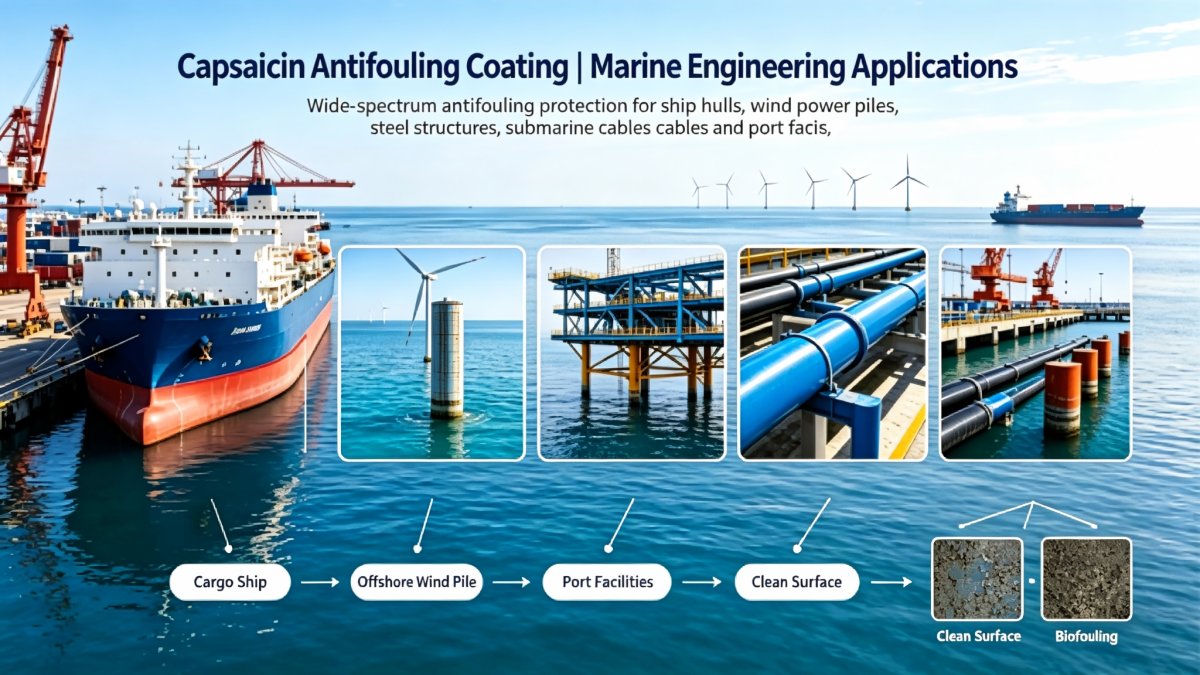
The application scenarios of this capsaicin-modified eco-friendly marine anticorrosive and antifouling coating are far more than just ships.
All metal structures that are in long-term contact with seawater and face the problems of corrosion and marine organism adhesion can use it.
Shipbuilding Industry
- Bottom and waterline area of ocean-going cargo ships
- Hulls of offshore fishing boats and aquaculture boats
- Underwater parts of yachts and official ships
- Accessories such as ship propellers and rudder blades
Value: Reduce sailing resistance, reduce fuel consumption, extend dock repair cycle, and reduce maintenance costs.
Marine Engineering
- Offshore wind power pile foundations and underwater structures
- Jacket of offshore oil platforms
- Piers and underwater foundations of cross-sea bridges
- Submarine pipelines and submarine cables
Value: Extend the service life of facilities, reduce underwater maintenance operations, and reduce operation and maintenance costs.
Coastal Facilities
- Steel structures of ports and wharves
- Cooling water systems of coastal power plants
- Steel structures of coastal industrial facilities
- Outdoor electrical cabinets and equipment
Value: Resist salt spray corrosion and marine atmospheric corrosion, and protect the safe operation of equipment and facilities.
Aquaculture
- Aquaculture net cages and net cage frames
- Aquaculture boats and operating platforms
- Aquatic product processing facilities and equipment
Value: Reduce marine organism adhesion, maintain smooth water flow, and reduce cleaning and maintenance frequency.
──────────────────────────────────────────────────
5. Why Jindao? Why Now?
Some people may ask: Why does a chili enterprise want to produce marine coatings?
The answer is simple: Because we have core raw materials that others do not have, and technical accumulation that others cannot achieve.
Raw Material Advantage: From Field to Laboratory, the Whole Chain is Independently Controllable
Jindao has been engaged in the chili industry for 26 years. From breeding to planting, from extraction to deep processing, the entire industrial chain is independently controllable.
- 200,000 mu of core planting bases: Layout in multiple production areas including Yunnan, Guizhou, Sichuan, Hunan, Hubei, Xinjiang and Guangxi, with sufficient and stable raw material supply
- 99.99% high-purity capsaicin: Naturally extracted, non-synthetic, with stable quality and guaranteed supply
- Full series of capsaicin products: Oleoresin capsicum, chili extract, capsanthin, capsaicin, covering all grades from food grade to pharmaceutical grade
For the production of capsaicin-modified coatings, Jindao has raw material cost advantages and quality guarantees that others cannot match.
Technical Advantage: From Extraction to Modification, Interdisciplinary R&D Capability
Capsaicin extraction is one thing, but integrating capsaicin into coatings is another.
Jindao Capsaicin has established an interdisciplinary R&D team covering multiple professional fields such as natural product extraction, polymer materials, and coating formulas. Relying on its own R&D laboratory, it has continued to invest in technological research and development, and has overcome key technologies such as capsaicin microencapsulation, coating system compatibility, and controlled release.
Not all chili enterprises can produce marine coatings. Behind this is long-term technical accumulation and continuous R&D investment.
Timing Advantage: Tightening Environmental Policies Lead to Explosive Demand for Alternatives
Why now? Because the time has come.
Global marine environmental protection policies continue to tighten, and the market space for traditional toxic antifouling paints is getting smaller and smaller. Shipowners, marine engineering owners, and coating enterprises are all looking for more eco-friendly alternative solutions.
The capsaicin-modified eco-friendly marine anticorrosive and antifouling coating is exactly at this tuyere.
Natural, eco-friendly, efficient – these three key words are not only the characteristics of Jindao’s products, but also the needs of the times.
Epilogue: The Infinite Possibilities of a Chili
Ever since Professor Xu Huashun planted the first industrial chili in the experimental field 26 years ago, Jindao has been exploring one thing: How many possibilities does a chili have?
26 years have passed, and the answer is becoming more and more abundant.
It can be the super spicy flavor on the dining table, the spiciness-enhancing raw material for the food industry, an effective analgesic in the medical field, a core component of security equipment, the heating factor in beauty products, a biological insect repellent in the agricultural field…
And today, it has a new identity: Ocean Guardian.
From the field to the factory, from food to medicine, from land to ocean – Jindao Capsaicin is using a small chili to continuously expand the boundaries of the industry.
The capsaicin-modified eco-friendly marine anticorrosive and antifouling coating is the first product of Jindao entering the marine new material field, but it will never be the last.
In the future, Jindao will continue to increase R&D investment, continue to deepen the application scenarios of high-purity capsaicin, launch more innovative products, and bring the value of natural capsaicin to more industries and fields.
The story of a chili is far from over.
And the blue ocean is Jindao’s next starting point.