
Abstract
After multiple generations of selective breeding and multi-site trials, Jindao Capsaicin Technology’s brand-new industrial pepper variety, the “Boundary-Breaking Pepper,” has completed technical validation. Its pungency stably reaches 1.5 million SHU in laboratory conditions and is equally maintained at the 1.5 million SHU level under large-scale field cultivation. This breakthrough addresses the industry-wide pain point of pungency decline in domestic ultra-high-pungency industrial peppers when grown in open fields, providing a new domestic ultra-high-pungency raw material option for the deep-processing industries of capsaicin, oleoresin capsicum, and capsanthin, and driving the domestic industrial pepper industry chain to advance upstream toward germplasm innovation.
Preface
The Scoville Heat Unit (SHU) is the internationally accepted scale for measuring the pungency of chili peppers. For a long time, ultra-high-pungency industrial peppers exceeding one million SHU have been a scarce resource in the industrial raw materials sector.
Many ultra-high-pungency pepper materials have historically demonstrated high heat only in laboratories and small-scale test plots. Once expanded to large-scale field cultivation, pungency drops significantly due to the combined environmental influences of sunlight, temperature variation, soil conditions, precipitation, and field management. It has been difficult to stably maintain million-level SHU output, which has become a major bottleneck restricting the development of China’s high-purity capsaicin industry.
Amid the rapid expansion of the industrial pepper industry, downstream sectors such as pharmaceutical intermediates, marine antifouling coatings, biological insect repellents, security and protection products, and feed additives are seeing rising demand for ultra-high-pungency raw materials with stable heat, low batch-to-batch variation, and scalable supply. Raw materials from common industrial peppers ranging from 200,000 to 1 million SHU can no longer meet the specification requirements of some high-end deep-processing applications.
The breeding R&D team at Jindao Capsaicin Technology, led by Professor Xu Huashun, a leading authority in chili pepper breeding in China, has continuously tackled key technical challenges. After more than two decades of systematic breeding, multiple generations of hybrid selection, and multi-site regional trials, the team is proud to launch the Jindao Boundary-Breaking Pepper — achieving stable 1.5 million SHU pungency in both laboratory and field-grown scenarios, and filling a critical gap in domestic ultra-high-pungency industrial pepper germplasm.
I. Breaking Boundaries: 1.5 Million SHU — Dual Stability from Lab to Field
There is a general consensus in the industrial pepper industry: achieving high pungency in the laboratory is not difficult — the real hard-core capability is maintaining high heat consistently in open-field cultivation.
There is a general consensus in the industrial pepper industry: achieving high pungency in the laboratory is not difficult — the real hard-core capability is maintaining high heat consistently in open-field cultivation. Many wild ultra-pungent pepper resources show impressive pungency in small-scale test environments, but when expanded to field cultivation, capsaicin synthesis is hindered by changes in rainfall, temperature fluctuations, and differences in soil fertility. Pungency often plummets sharply, and raw material batches vary widely in heat, causing significant production challenges for downstream extraction enterprises. Excessive pungency fluctuation in each batch of raw material at extraction plants directly alters extraction process parameters, drives up purification costs, and makes it difficult to guarantee the purity and yield of finished capsaicin — directly affecting the quality of downstream end products.
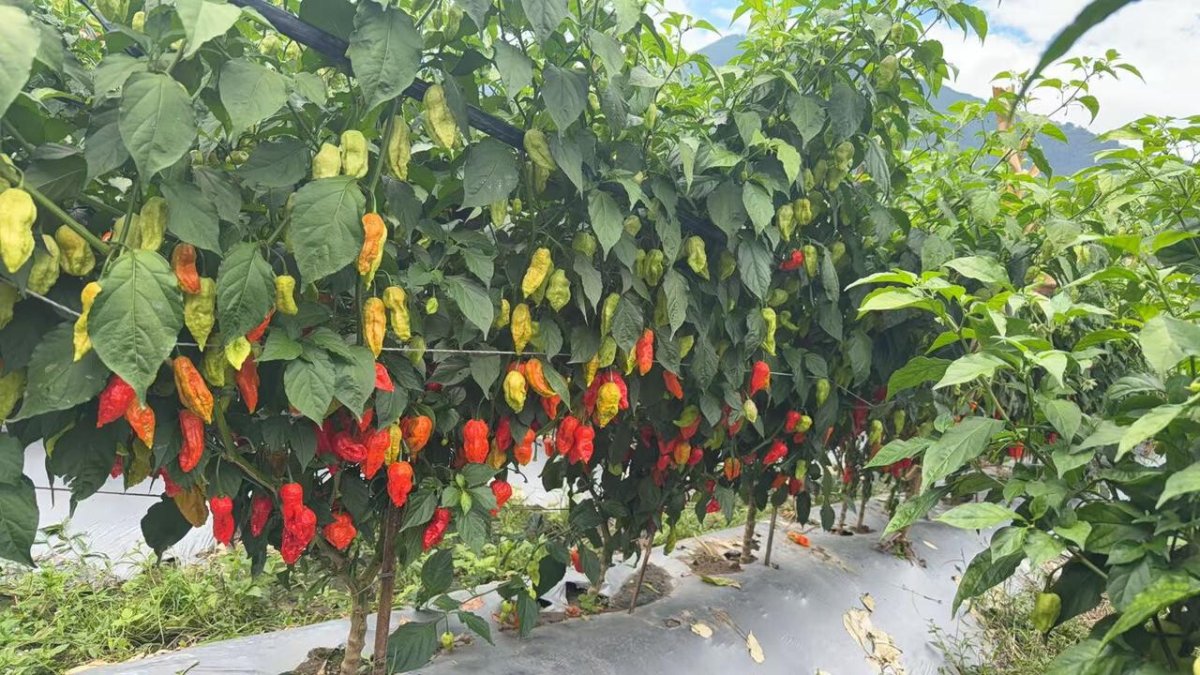
Crop Characteristics
The field is planted with a high-pungency pepper variety with distinctly wrinkled skin (suspected to be a Bhut Jolokia / Shuanshuanla type variety). Plants are cultivated in neat rows with lush foliage; ovate dark green leaves are layered densely, and branches are heavily laden with fruit at various stages of maturity:
- Unripe fruit is tender green, light yellow/orange-yellow, with relatively mild wrinkling;
- Fully ripe fruit is bright true red, with distinctly wrinkled skin and plump form. Fruit set is extremely high, weighing branches downward; horizontal tension wires and support poles are set up in the field, paired with fixed wooden stakes at plant bases to prevent lodging from excessive fruit load.
Growing Environment
- Silver-gray agricultural mulch film is laid between ridges, which suppresses weed growth, reduces water evaporation, and prevents fruit from directly contacting the ground. A small amount of dry fallen leaves and dropped small fruits are scattered on the mulch surface;
- The background offers an open view with rolling dark green distant mountains under a clear light-blue sky dotted with wispy white clouds. With abundant sunlight, this is a mountain cultivation scene with good ecological conditions.
──────────────────────────────────────────────────
Many wild ultra-pungent pepper resources show impressive pungency in small-scale test environments, but when expanded to field cultivation, capsaicin synthesis is hindered by changes in rainfall, temperature fluctuations, and differences in soil fertility. Pungency often plummets sharply, and raw material batches vary widely in heat, causing significant production challenges for downstream extraction enterprises. Excessive pungency fluctuation in each batch of raw material at extraction plants directly alters extraction process parameters, drives up purification costs, and makes it difficult to guarantee the purity and yield of finished capsaicin — directly affecting the quality of downstream end products.
The Jindao Boundary-Breaking Pepper has undergone consecutive seasons of breeding iteration, screening of thousands of materials, and multi-site cross-regional deployment trials. Under laboratory testing conditions, sample pungency is stably locked at 1.5 million SHU. More critically, across multiple demonstration field bases in Yunnan, Guizhou, Sichuan, Guangxi, and other regions — after full growth-cycle field measurements with standard cultivation management and no special greenhouse environment required — pungency indicators are basically stably maintained at 1.5 million SHU, with batch-to-batch pungency fluctuation controlled within a reasonable range. This solves the industry-wide challenge of pungency decline in ultra-high-pungency varieties.
To help everyone intuitively understand what 1.5 million SHU means, here is a straightforward comparison:
- Common small millet peppers measure approximately 30,000–50,000 SHU;
- Mainstream high-pungency industrial peppers on the market generally range from 600,000 to 1 million SHU;
- The Jindao Boundary-Breaking Pepper stably reaches 1.5 million SHU in field cultivation — its pungency far exceeds mainstream industrial pepper varieties on the market.
⚠ IMPORTANT SAFETY NOTICE: This variety is a dedicated industrial extraction pepper and is strictly prohibited from direct consumption. Fresh fruit harvesting operations must be performed with full protective gloves to avoid skin and mucous membrane contact with peel juice, which can cause intense capsaicin irritation and burns. The fruit is not intended for the culinary fresh food market and is used exclusively as industrial deep-processing raw material.
II. Core Variety Advantages: Beyond Ultra-High Pungency, Optimized for Industrial Cultivation
Ultra-high pungency is only the core label of the Jindao Boundary-Breaking Pepper. As an industrial variety designed for large-scale contract farming, it balances multiple indicators — pungency, yield potential, stress resistance, and harvest adaptability — and is suitable for various cultivation regions in southwest and south China.
Ultra-high pungency is only the core label of the Jindao Boundary-Breaking Pepper. As an industrial variety designed for large-scale contract farming, it balances multiple indicators — pungency, yield potential, stress resistance, and harvest adaptability — and is suitable for various cultivation regions in southwest and south China. 1. Strong capsaicin accumulation capacity, higher raw material utilization efficiency
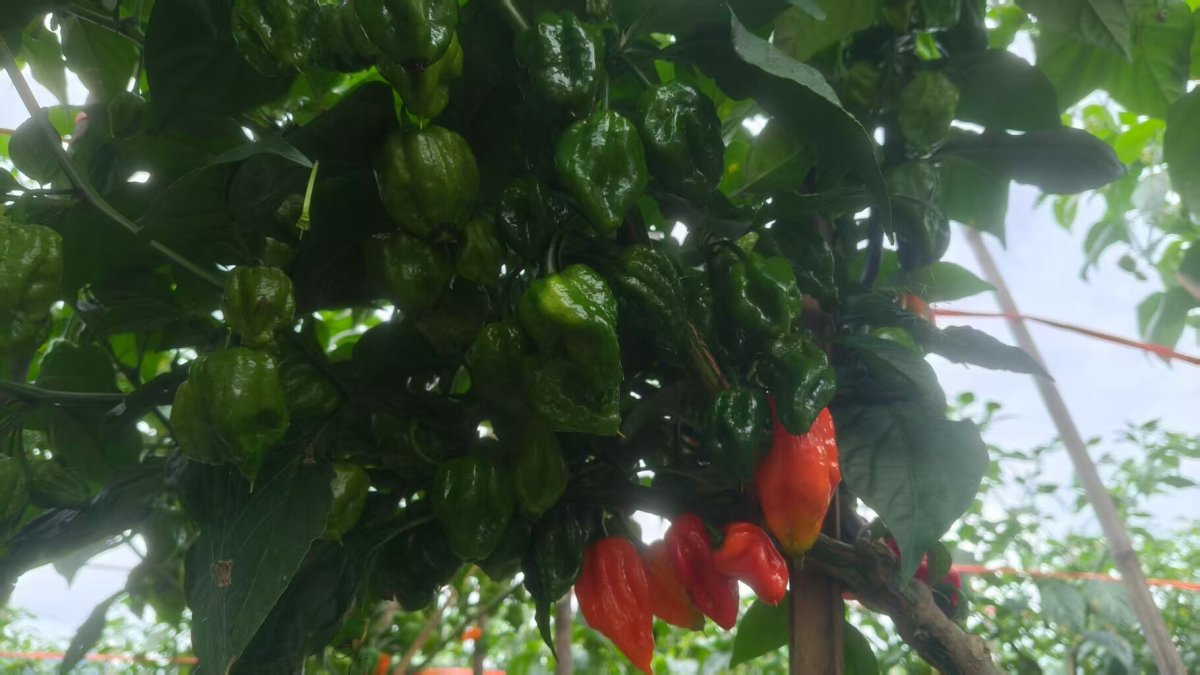
Image Content Description
This is a real photo of pepper plants in the fruiting stage under greenhouse cultivation, full of vitality:
Fruit characteristics: The plants have extremely high fruit set, with dense fruit covering the branches:
- Most are unripe dark green fruit with distinctly wrinkled skin covered in a natural moist sheen, short and plump in shape approaching a lantern form, with a protruding pointed tip — typical morphological features of high-pungency peppers (such as Bhut Jolokia / Shuanshuanla types);
- In the lower right of the frame, several fully ripe fruits have turned bright orange-red, plump and striking, forming a vivid contrast with the surrounding green fruit.
Plants and environment:
- The pepper leaves are broad and deep green with clear veins, interspersed with the fruit. Wooden stakes are placed beside the stems to help support the heavy fruit load;
- In the background, greenhouse support bamboo poles and orange tie-down ropes are visible, with rows of similar pepper plants further away. Natural light filters in from above, indicating a large-scale artificial cultivation scene with vigorously growing crops.
1. Strong Capsaicin Accumulation Capacity, Higher Raw Material Utilization Efficiency
For the same weight of fresh fruit, capsaicin content is higher. When downstream extraction enterprises process, the quantity of raw material consumed per unit of high-purity capsaicin output decreases, effectively reducing the comprehensive costs of raw material storage, transportation, and extraction processing. For factories producing high-concentration oleoresin capsicum and high-purity capsaicin raw materials, stable 1.5 million SHU field-grown raw materials can simplify purification processes and improve production efficiency.
2. Outstanding Disease and Stress Resistance, Effectively Reducing Planting Risk
This variety has undergone targeted disease resistance improvement and possesses excellent resistance to anthracnose, sunscald, and other common pepper diseases, greatly reducing flower and fruit drop and fruit damage caused by disease. Plants branch vigorously, with stable continuous fruit set and dense fruiting. They have strong adaptability to relatively marginal land conditions such as mountainous areas, sloping land, and abandoned farmland, with a greater margin for error. Highly compatible with industrial pepper contract farming models across regions, they help revitalize low-efficiency idle land resources.
3. Long Harvest Cycle, Supporting Multi-Batch Picking
With a reasonable maturation cycle, multi-roundbatch-by-batch harvesting is achievable, extending the operational window and alleviating labor pressure during concentrated harvest periods. Fresh fruit has a regular shape and uniform ripening color change, facilitating manual harvesting and initial sorting at bases. It is compatible with on-site drying and primary processing models at production origins, reducing fresh fruit loss during long-distance transportation.
4. Outstanding Yield Performance, Excellent Per-Mu Output
Single-plant fruit set can reach 400–500 fruits, with a large fruiting base. Under standardized field management conditions, maximum yield can exceed 2 tons per mu, with considerable output efficiency. The ultra-high single-plant fruit volume effectivelyincreases raw material output per unit area at the base,reducing the comprehensive costs of planting, harvesting, and transportation, and bringing better economies of scale to growing entities.
5. Controllable Batch Pungency, Adapted to Industrial Standardized Production
What the downstream deep-processing industry fears most is fluctuating raw material pungency. The Jindao Boundary-Breaking Pepper has been verified across multiple bases: under standardized cultivation management, pungency output is stable across different plots and different harvest batches, enabling processing enterprises to establish standardized production processes and achieve stable product quality output — suitable for industries with stringent raw material consistency requirements such as pharmaceuticals and advanced materials.
III. 1.5 Million SHU Ultra-High-Pungency Raw Material Unlocking New Industrial Application Frontiers
Capsaicin and capsanthin are the two core extracts of industrial peppers. With its 1.5 million SHU ultra-high-pungency base, the Jindao Boundary-Breaking Pepper further expands the application boundaries of natural pepper extracts, covering multiple sectors including pharmaceutical health, eco-friendly advanced materials, agricultural and forestry protection, security, and animal feed.
1. Pharmaceutical and Health Sector
High-purity capsaicin is an important pharmaceutical intermediate, widely used in topical analgesic ointments and pain relief patches for external physiotherapy targeting neuralgia and joint/muscle pain. It is also a core raw material for various antipruritic and anti-inflammatory topical preparations. 1.5 million SHU grade raw materials can support the production of higher-purity capsaicin, helping pharmaceutical enterprises R&D and iterate new topical preparation products.
2. Eco-Friendly Industrial Advanced Materials Sector
Capsaicin, with its natural irritant properties, is used in green antifouling coatings. Adding capsaicin to marine antifouling paints inhibits the attachment of barnacles and other marine fouling organisms to ship hulls. Adding capsaicin to cable and optical cable sheath coatings repels rodent gnawing damage, reducing pipeline operation and maintenance losses. Compared with some chemical additives, natural capsaicin offers the advantages of environmental friendliness and biodegradability, representing an important direction for green advanced materials. Ultra-high-pungency raw materials can reduce the amount of pepper extract added per unit of finished product, optimizing coating formulation systems.
3. Agriculture and Forestry Sector
Extracted capsaicin is used to prepare biological insect-repellent pesticides that repel aphids and underground pests — low-toxic and eco-friendly, aligning with the direction of green agricultural development. Pepper meal by-products, after processing, can be used as feed raw materials, achieving comprehensive utilization of the whole fruit and enhancing the economic value of the entire pepper plant. Capsaicin preparations produced from ultra-high-pungency raw materials further unlock insect-repellent efficacy potential.
4. Security and Protection Sector
As the core raw material for non-lethal protective products, ultra-high capsaicin is the base material for security sprays and similar products. Stable high-pungency raw materials are the foundational guarantee for the performance stability of security products.
5. Food and Daily Chemical Sector
Capsanthin is simultaneously extracted from the fruit and used as a natural colorant in meat products, condiments, cosmetics and lipsticks, achieving multiple extractions from one pepper and maximizing the economic value of the whole fruit.
IV. Full Industry Chain Layout: The Jindao Solution from Germplasm to Deep Processing
The Boundary-Breaking Pepper is not an isolated variety — it is a core component of Jindao Capsaicin Technology’s full industry chain layout. As a professional source supplier of standardized pungency products, Jindao Capsaicin Technology, relying on core varieties such as the Boundary-Breaking Pepper, has built full industry chain service capabilities spanning breeding R&D, large-scale cultivation, primary processing, deep extraction, and deep-processing applications.
1. Breeding R&D
Professor Xu has been deeply engaged in the industrial pepper field for many years, possessing R&D capabilities across multiple technical routes including systematic breeding, hybrid breeding, and molecular marker-assisted breeding. The team continuously iterates varieties to maintain technological leadership.
2. Large-Scale Cultivation
Core cultivation bases have been established in Fujian, Guangxi, Yunnan, Hainan, and other regions, adopting a “company + base + farmer” cooperation model with unified seed supply, technical guidance, and procurement standards — guaranteeing raw material quality and supply stability from the source. Fresh peppers are concentrated on the market from July to October, while processed products such as dried peppers, pepper powder, and oleoresin capsicum are stably supplied 365 days a year.
3. Full Product Matrix
Centered on the Boundary-Breaking Pepper as the core variety, Jindao Capsaicin Technology has formed a complete product matrix including pepper seedlings, fresh peppers, explosive spicy fresh pepper sauce, dried peppers, pepper powder, oleoresin capsicum, capsanthin, capsaicin, and pepper meal — meeting the diverse needs of customers across different industries and scales.
4. Full Traceability
Full-process quality control from cultivation to processing, from extraction to finished products ensures every batch meets high-standard requirements.
V. Industrial Value: Breaking Through Upward, Completing the Domestic Industrial Pepper Germplasm Landscape
Looking back at the development of China’s industrial pepper industry, in earlier years some high-pungency industrial pepper germplasm resources relied on external introductions, with pain points including high seed source costs, poor local adaptability, and field pungency decline. In recent years, domestic breeding efforts have gained momentum — varieties such as Jindao No. 1 have achieved million-level SHU large-scale implementation, driving the rapid development of China’s industrial pepper industry.
The realization of the Jindao Boundary-Breaking Pepper with stable 1.5 million SHU in field cultivation marks another step forward for domestic industrial pepper germplasm. It is no longer merely laboratory germplasm, but a truly commercial variety that can go to the fields, go to contract bases, and meet the real production needs of downstream factories.
From the upstream cultivation perspective, ultra-high-pungency varieties offer higher raw material premium space. Under the contract-based guaranteed procurement model, cooperative planting cooperatives and farmers can obtain better purchase income from high-quality ultra-high-pungency fresh fruit, converting sloping land and abandoned farmland resources into industrial income — helping to build rural characteristic industries and achieving win-win outcomes for enterprises, processing plants, and growers.
From the downstream processing perspective, the domestic supply of stable ultra-high-pungency raw materials helps reduce domestic deep-processing enterprises’ dependence on foreign special raw materials, shortens supply chains, improves supply chain security, and provides raw material support for the export of capsaicin and oleoresin capsicum related products.
Currently, Jindao Capsaicin has established deep cooperative relationships with multiple industry-leading enterprises. The choice of leading enterprises is the best proof of Jindao’s product quality and service capabilities. Right now is the peak of the national industrial pepper concentrated harvest season, with fresh fruit successively coming to market across major bases and increasingly fierce market competition for high-pungency high-quality raw materials. The launch of the Jindao Boundary-Breaking Pepper provides a brand-new option for the entire industry. Going forward, Jindao will continue to carry out multi-site demonstration cultivation, improve supporting cultivation technical procedures, and output standardized seedling raising, field management, and harvesting technical solutions — empowering partner bases to carry out standardized cultivation and ensuring field pungency indicators are delivered.
VI. The Industrial Boundary-Breaking of a Single Pepper
A bright red pepper — not for the dining table, but entering factories and laboratories, empowering multiple industries including pharmaceuticals, advanced materials, agriculture and forestry, and security.
The Jindao Boundary-Breaking Pepper breaks more than just the 1.5 million SHU pungency number — it shatters the industry constraint that “ultra-high pungency can only survive in the laboratory,” achieving the leap from laboratory indicators to stable field mass production. Starting from germplasm innovation, itconnects the entire chain of “breeding — seedling raising — base cultivation — primary processing — deep processing — downstream applications,” unlocking greater industrial value from domestic industrial peppers.
In the future, Jindao Capsaicin will continue to deepen its commitment to high-pungency industrial pepper breeding and full industry chain construction, continuously refining variety performance, improving industrial services, and partnering with cultivation and processing stakeholders to jointly promote the high-quality development of China’s industrial pepper industry.
In the future, Jindao Capsaicin will continue to deepen its commitment to high-pungency industrial pepper breeding and full industry chain construction, continuously refining variety performance, improving industrial services, and partnering with cultivation and processing stakeholders to jointly promote the high-quality development of China’s industrial pepper industry.