Capsanthin is the key carotenoid pigment responsible for the bright red color of chili pepper fruits, and its content directly determines their commercial and nutritional value. However, the transcription factors regulating capsanthin biosynthesis and their underlying molecular mechanisms had remained unclear. Recently, a research team—led by the Institute of Modern Agriculture at Peking University and involving the Xinjiang Academy of Agricultural Sciences—successfully identified an ALOG-family transcription factor, CaLSH10. They revealed the molecular mechanism by which CaLSH10 promotes capsanthin biosynthesis through the direct activation of the key biosynthetic gene CCS (Capsanthin-Capsorubin Synthase). These findings were published in the academic journal Plant Communications under the title “An ALOG family transcription factor promotes capsanthin production by activating the expression of Capsanthin-Capsorubin Synthase gene in pepper.”
The biosynthesis of capsanthin is catalyzed by capsanthin-capsorubin synthase (CCS), yet the transcriptional regulatory mechanism governing the CCS gene has long remained elusive. The research team first employed an in vitro DNA pull-down assay coupled with mass spectrometry (DNApd-MS)—using the promoters of key genes in the capsanthin biosynthetic pathway (PSY1, PSY2, ZEP, and CCS) as bait—to screen for transcription factors capable of binding to these promoters within protein extracts from pepper pericarp. Luciferase reporter assays revealed that, among 14 candidate transcription factors, CaLSH10 was the only one capable of simultaneously activating both PSY1 and CCS promoters, suggesting it occupies a central position in the regulatory network.
CaLSH10 belongs to the ALOG family of transcription factors—a group conserved across plant species—and contains an ALOG domain responsible for DNA binding. Using amplified DNA affinity purification sequencing (ampDAP-seq), the team identified over 260,000 CaLSH10 binding sites across the genome and determined that the core DNA motif recognized by CaLSH10 is the 7-bp sequence YACTRTW. Electrophoretic mobility shift assays (EMSA) and microscale thermophoresis (MST) analysis further confirmed that CaLSH10 specifically binds to this motif within the CCS promoter, and that mutation of the motif completely abolishes this interaction.
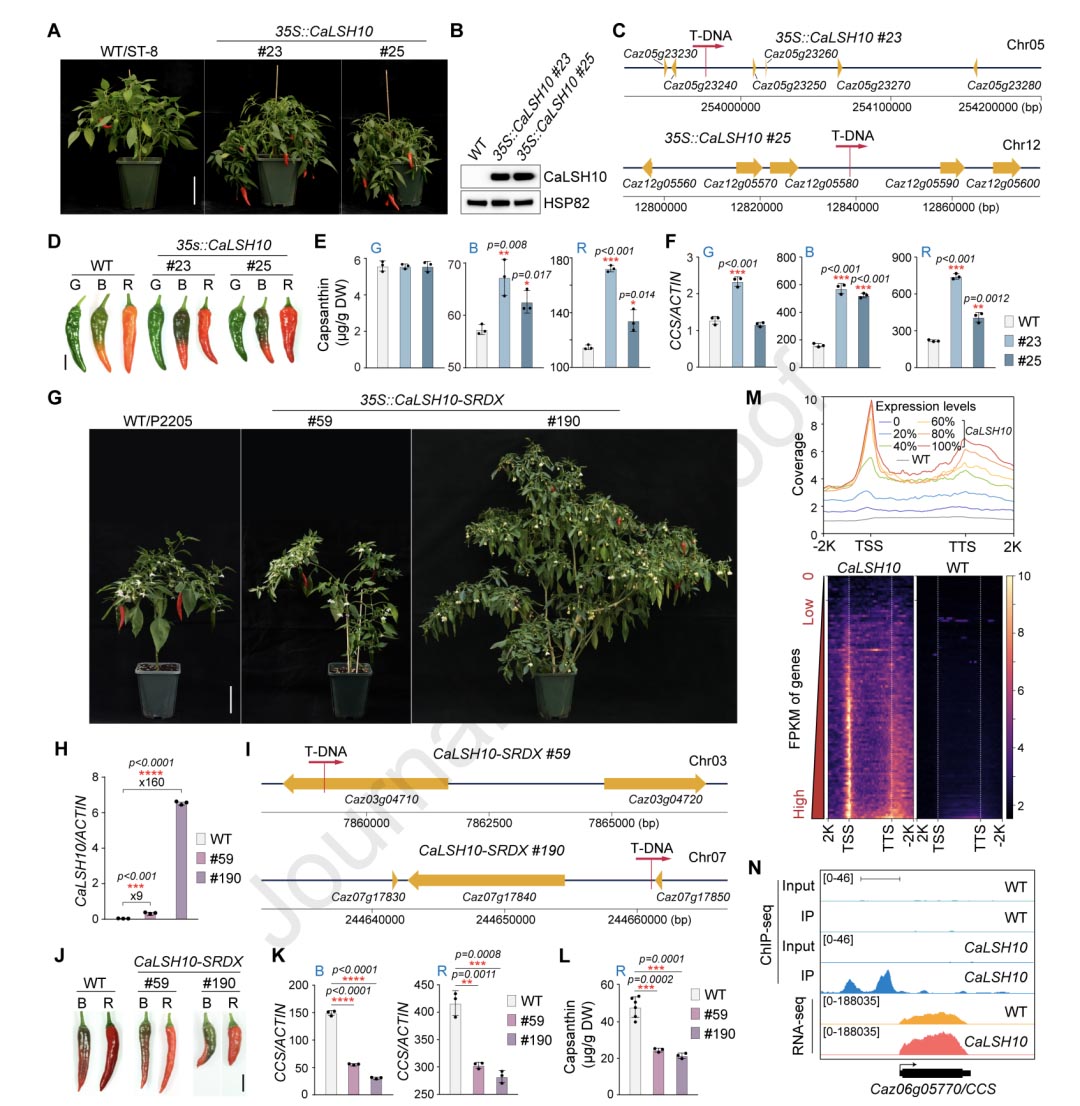
To investigate the biological function of CaLSH10, the team generated transgenic pepper plants overexpressing CaLSH10. Phenotypic analysis showed that, compared to wild-type plants, the overexpression lines exhibited no significant changes in fruit morphology or weight but displayed a marked increase in capsanthin content—up to 50% higher—accompanied by a concurrent upregulation of CCS transcript levels; these results indicate that CaLSH10 positively regulates CCS expression and capsanthin biosynthesis. To further address potential functional redundancy among ALOG family members, the team employed the chimeric repressor silencing technology (CRES-T) by fusing the SRDX repression domain to the C-terminus of the CaLSH10 protein, thereby generating CaLSH10-SRDX transgenic plants. The results showed that both CCS expression and capsanthin content decreased significantly, confirming—from a reverse genetics perspective—that CaLSH10 is essential for capsanthin biosynthesis.
Through an analysis combining chromatin immunoprecipitation sequencing (ChIP-seq) and RNA sequencing (RNA-seq), the research team discovered that CaLSH10 primarily binds to promoter regions near transcription start sites across the genome, with binding intensity positively correlated to gene expression levels. Among genes in the carotenoid biosynthesis pathway, CaLSH10 directly binds to the promoters of CCS, PSY1, CHYB2, and CRTISO; however, it significantly activates the transcription of CCS alone, indicating that CaLSH10’s regulation of CCS is target-gene specific.
In summary, this study systematically elucidates for the first time the key regulatory role of the ALOG family transcription factor CaLSH10 in capsanthin biosynthesis and establishes the “CaLSH10-CCS-capsanthin” transcriptional regulatory pathway, thereby providing important genetic resources and regulatory targets for the molecular breeding of pepper fruit quality.