
Capsaicin is a unique secondary metabolite found in chili peppers, contributing its distinctive spicy flavor and possessing significant food and medicinal applications. HD-ZIP transcription factors play a crucial role in plant growth, development, and secondary metabolism regulation, but their function in capsaicin biosynthesis remains unclear. Recently, a research team from Guizhou University and other institutions systematically identified the chili pepper HD-ZIP transcription factor family and revealed the molecular mechanism by which CaHAT5 positively regulates capsaicin biosynthesis during fruit development by directly binding to and activating the promoter of the key synthase gene CaAT3. The relevant research findings, titled “CaHAT5 positively regulates capsaicinoid biosynthesis by directly activating CaAT3 expression during fruit development in pepper,” were published in the academic journal Plant Science.
This study first performed transcriptome sequencing and capsaicin content determination on placental tissues from five developmental stages of chili pepper fruits (20, 30, 37, 45, and 55 DPA). The results showed that the contents of capsaicin and dihydrocapsaicin peaked at 37 DPA and then gradually decreased. By systematically analyzing the correlation between the expression patterns of HD-ZIP family genes and capsaicin content, the candidate gene CaHAT5 (Capana02g003485), which is highly positively correlated with capsaicin accumulation, was screened. Subcellular localization showed that CaHAT5 is located in the cell nucleus, consistent with its functional characteristics as a transcription factor.
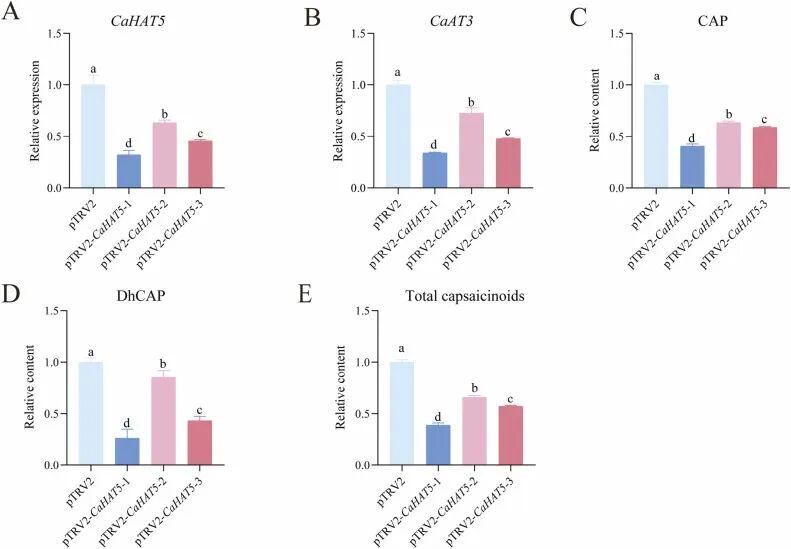
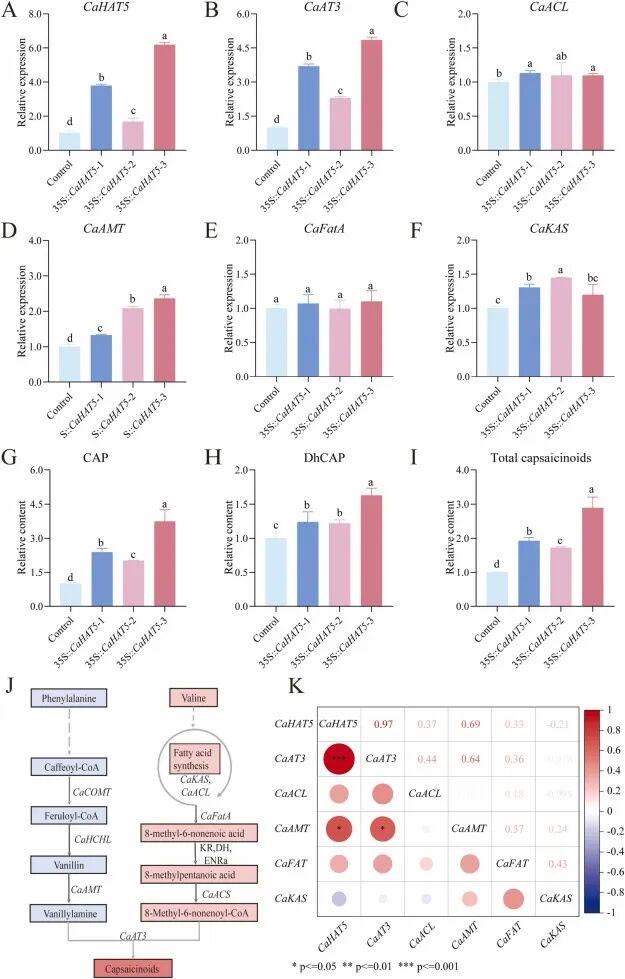
Functional validation showed that transient overexpression of CaHAT5 in chili pepper fruits increased capsaicin and dihydrocapsaicin contents to 2.38-fold and 1.92-fold, respectively, and total capsaicin content to 1.92-fold. Conversely, silencing CaHAT5 using viral-induced gene silencing significantly decreased capsaicin content. qRT-PCR analysis showed a significant positive correlation between CaHAT5 expression changes and the expression of the key capsaicin synthase gene CaAT3, while no significant correlation was found with other synthase genes (CaACL, CaAMT, CaFatA, CaKAS), suggesting that CaAT3 is a key downstream target gene of CaHAT5.
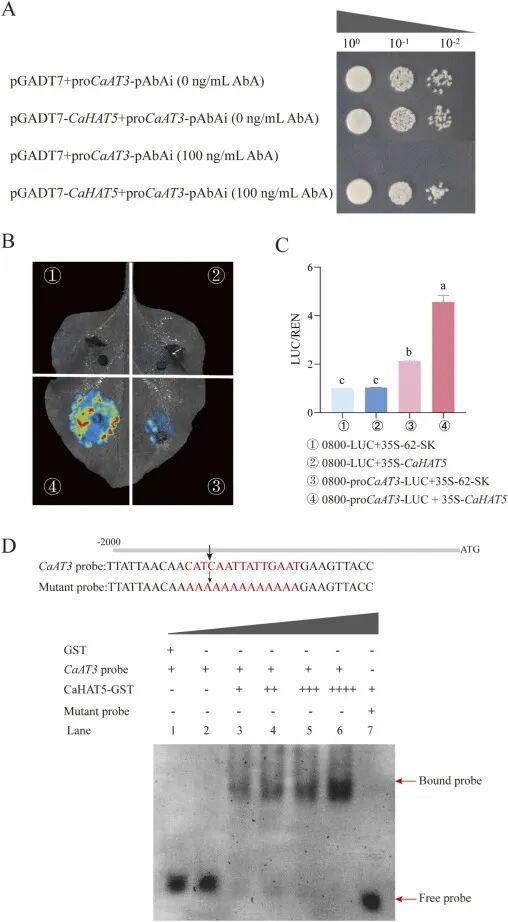
Further experiments using yeast one-hybrid assays, dual-luciferase reporter assays, and electrophoretic mobility shift assays confirmed that CaHAT5 can directly bind to the HDZ motif (CAATNATTG) in the CaAT3 promoter, activating its transcription. This regulatory module is highly expressed in the early stages of fruit development (20-37 DPA), coinciding with the peak period of capsaicin accumulation.
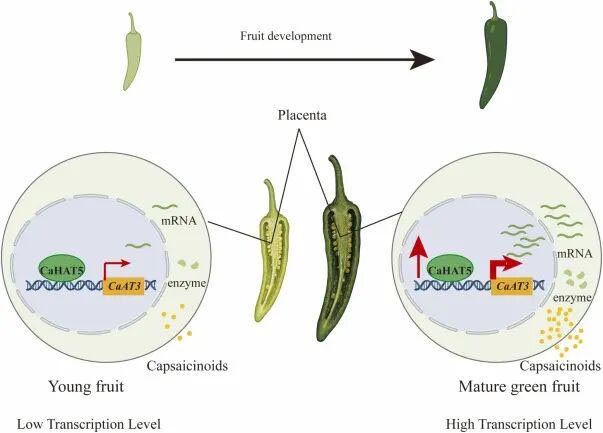
In summary, this study is the first to reveal the molecular mechanism by which the HD-ZIP transcription factor CaHAT5 positively regulates capsaicin biosynthesis during pepper fruit development by directly binding to and activating the CaAT3 promoter, and proposes a CaHAT5-CaAT3 regulatory module model. This research not only expands our understanding of the transcriptional regulatory network of capsaicin synthesis but also provides new gene resources and theoretical basis for the molecular improvement of pepper spiciness.